Private Fund vs ETF
Private Fund vs ETF
기관 투자자의 관점에서 상장지수펀드(ETF)와 비교하여 사모펀드(PE), 사모부채(PD), 부동산에 자본을 배분하는 주요 이점은 장기 수익률, 분산 투자, 그리고 리스크 관리 측면에서 매우 뚜렷하게 나타납니다. ETF는 유동성과 투명성이 높지만, 기관 투자자들은 긴 투자 시계를 활용하여 '비유동성 프리미엄'을 확보하고 시장 수익률(Alpha)을 초과하는 성과를 추구하기 위해 대체 투자로 눈을 돌립니다.
1. 장기 수익률 (Long-term Returns)
* 비유동성 프리미엄 (Illiquidity Premium): 사모 자산은 공모 시장처럼 쉽게 매각하여 현금화할 수 없습니다. 대신 투자자들은 자금이 묶이는 것에 대한 보상으로 더 높은 절대 수익, 즉 비유동성 프리미엄을 요구하고 받게 됩니다. 당장 단기적인 현금 흐름이 필요하지 않은 연기금이나 국부펀드 등에게는 7~10년의 자본 잠금을 감수하고 더 높은 수익을 올리는 것이 훨씬 유리합니다.
* 적극적인 가치 창출 (사모펀드 - PE): 단순히 광범위한 시장 지수를 기계적으로 추종하는 패시브 ETF와 달리, 사모펀드는 기업의 경영권을 확보하여 적극적으로 개입합니다. 경영진 교체, 운영 비용 최적화, 전략적 인수합병(M&A) 등을 통해 기업의 펀더멘털 자체를 강화합니다. 이러한 능동적인 가치 창출은 시장의 변동성과 무관하게 독자적인 초과 수익(Alpha)을 만들어냅니다.
* 수익률 제고 (사모부채 - PD): 2008년 금융위기 이후 은행에 대한 규제가 강화되면서, 중견기업들은 사모부채 시장으로 자금 조달처를 옮겼습니다. PD는 전통적인 우량 회사채나 배당 ETF보다 높은 이자율(Yield)을 제공합니다. 또한 대다수의 사모 대출은 변동 금리(Floating Rate) 조건으로 발행되기 때문에, 금리 인상기에는 추가적인 이자 수익을 통해 포트폴리오의 수익률을 자연스럽게 방어하고 끌어올릴 수 있습니다.
2. 분산 투자 (Diversification)
* 상장 시장과의 낮은 상관관계: 주식 및 채권 ETF는 글로벌 거시경제 지표, 지정학적 이슈, 시장의 투자 심리에 따라 매일 급등락합니다. 반면 사모 자산은 공모 시장의 흐름과 상관관계(Correlation)가 낮습니다. 사모 자산의 성과는 전반적인 시장 심리보다는 해당 기업이나 자산 자체의 펀더멘털에 의해 결정되므로, 포트폴리오 전체의 변동성을 완화하는 훌륭한 분산 투자 도구가 됩니다.
* 비상장 경제로의 접근: 오늘날 전 세계 수많은 우량 기업과 혁신 기업들이 상장을 미루거나 아예 비상장 상태로 남아 있습니다. ETF에만 투자하는 것은 이러한 초기 스타트업이나 거대한 유니콘 기업들이 폭발적으로 성장할 때 발생하는 수익 기회를 완전히 놓치는 것을 의미합니다.
* 인플레이션 헤지 (부동산): 실물 부동산은 역사적으로 인플레이션을 방어하는 강력한 수단입니다. 물가가 상승하면 임대료를 인상할 수 있고, 자산 가치도 함께 상승하는 경향이 있습니다. 주식 시장에 상장된 리츠(REITs) ETF도 존재하지만, 이는 주식 시장이 폭락할 때 주식과 동조화되어 하락하는 경향이 강합니다. 반면 실물 부동산에 직접 투자하거나 사모 형태로 투자하면 진정한 의미의 분산 효과를 얻을 수 있습니다.
3. 리스크 관리 (Risk Management)
* 평가 방식과 변동성 축소: ETF는 매일 실시간으로 시가평가(Mark-to-Market)가 이루어져 단기적인 악재나 알고리즘 매매에 의해 가격이 왜곡될 수 있습니다. 반면, PE, PD, 실물 부동산은 분기 또는 연 단위로 감정평가(Appraisal-based pricing)를 통해 가치를 산정합니다. 비록 이것이 '장부상의 안정성'이라는 비판을 받기도 하지만, 실제 기관 투자자들에게는 시장의 패닉 속에서도 투매를 방지하고 자산부채관리(ALM)를 안정적으로 유지하게 해주는 강력한 심리적, 회계적 방어막이 됩니다.
* 구조적 안전장치 (Covenants): 사모부채 투자의 경우 채권자가 차입 기업과 직접 협상하여 엄격한 재무적 안전장치(Financial Covenants)를 설정합니다. 기업의 재무 상태가 악화될 조짐이 보이면 채권자가 즉시 개입할 수 있습니다. 또한, 자본 구조상 선순위 담보(Senior Secured)로 들어가는 경우가 많아 기업이 부도나더라도 광범위한 하이일드 채권 ETF에 비해 원금 회수율(Recovery Rate)이 훨씬 높습니다.
(1) 본 글은 특정 종목을 추천하기 위한 목적이 아니며, 투자에 대한 모든 책임은 개인에게 있습니다.
(2) 본 글은 AI의 도움을 받아 작성되었습니다.
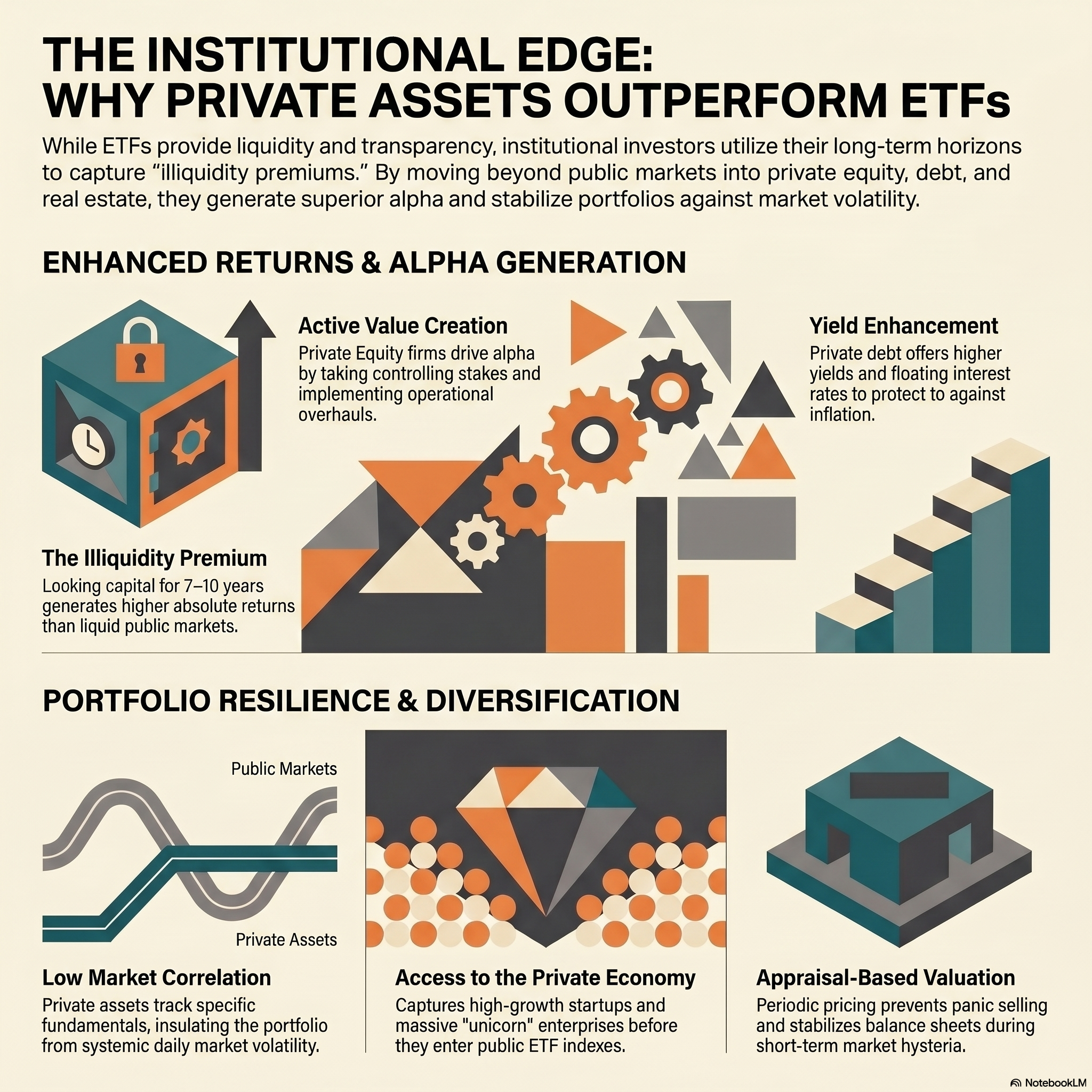
Private Fund vs ETF
From the perspective of institutional investors, the primary advantages of allocating capital to alternative assets—namely private equity (PE), private debt (PD), and real estate—over Exchange Traded Funds (ETFs) are highly distinct when evaluated through the lenses of long-term returns, diversification, and risk management. While ETFs offer superior liquidity and transparency, institutions often leverage their long investment horizons to capture an "illiquidity premium" and generate alpha.
1. Long-term Returns
* The Illiquidity Premium: Because private assets cannot be readily sold on public exchanges, investors are compensated with an illiquidity premium. Institutional investors, such as pension funds, endowments, and sovereign wealth funds, do not require daily liquidity. This allows them to lock up capital for 7 to 10 years in exchange for higher absolute returns compared to highly liquid public markets.
* Active Value Creation (Private Equity): Unlike passive ETFs that merely track a broad market index mechanically, PE firms take active, controlling stakes in companies. They implement operational overhauls, upgrade management teams, and execute strategic M&A. This hands-on approach drives fundamental business improvements and yields significant alpha that is independent of general market movements.
* Yield Enhancement (Private Debt): As traditional banks have pulled back from middle-market lending due to post-2008 regulations, private debt has stepped in to fill the void. PD typically offers higher yields than public bonds or broad dividend ETFs. Furthermore, because many private loans are structured with floating interest rates, they provide built-in protection and increased returns during rate-hiking cycles.
2. Diversification
* Low Correlation to Public Markets: ETFs are directly exposed to the daily volatility, geopolitical shocks, and systemic risks of global stock and bond markets. Alternative assets generally exhibit lower correlation to public market movements. Their performance is driven by asset-specific or company-specific fundamentals rather than broader market sentiment, effectively smoothing out the portfolio's overall volatility.
* Access to the Private Economy: Companies are staying private longer, meaning a massive portion of global economic growth and innovation occurs outside the public domain. An investor relying solely on equity ETFs completely misses out on the explosive growth of early-stage startups and massive private enterprises (unicorns) before they ever go public.
* Inflation Hedging (Real Estate): Real estate is a tangible asset that historically serves as a robust hedge against inflation. Rents can be adjusted upward as the cost of living increases, and underlying property values tend to rise accordingly. While REIT ETFs exist, they often trade like equities and suffer from high correlation to the stock market during crashes. Direct or private fund investments in real estate provide much truer diversification.
3. Risk Management
* Valuation Mechanics and Volatility: ETFs are marked-to-market daily, meaning their prices wildly swing based on market panic, algorithmic trading, and short-term news. Private markets, conversely, rely on periodic appraisal-based pricing (usually quarterly). While some critics label this "volatility laundering," it practically insulates institutional portfolios from short-term market hysteria, prevents panic selling, and stabilizes the balance sheet for consistent asset-liability management (ALM).
* Structural Protections (Covenants): In private debt, lenders negotiate directly with the borrower to establish strict financial covenants. If a company's financial health deteriorates, lenders can intervene early. Furthermore, private debt is often senior and secured in the capital structure, providing significant downside protection and substantially higher recovery rates in the event of default compared to broad high-yield bond ETFs.
(1) This article is not intended to recommend any specific stock, and individuals are solely responsible for their own investment decisions.
(2) This article was written with the assistance of AI.