-
제번스의 역설 (Jevons Paradox)손 가는 대로/그냥 2026. 3. 27. 19:45728x90
제번스의 역설 (Jevons Paradox)
Korean Version제번스의 역설은 기술의 발전으로 자원 이용의 효율성이 높아졌음에도 불구하고, 해당 자원의 전체 소비량은 오히려 증가하는 현상을 의미합니다.
개념의 유래1865년 영국의 경제학자 윌리엄 스탠리 제번스(William Stanley Jevons)가 그의 저서 《석탄 문제》에서 처음 제시하였습니다. 그는 증기기관의 효율성이 향상되면서 석탄 소비가 줄어들 것으로 예상했으나, 실제로는 증기기관의 보급이 확대되어 석탄 수요가 폭발적으로 증가하는 것을 목격하였습니다.
주요 메커니즘- 효율성 향상: 단위 생산당 필요한 자원의 양이 감소합니다.
- 비용 하락: 자원 이용 비용이 낮아지면서 수요가 탄력적으로 반응합니다.
- 반등 효과: 절약된 비용으로 더 많은 서비스를 이용하거나 새로운 분야에 도입하면서 결과적으로 총 소비량이 늘어납니다.
현대적 사례- 에너지 효율: 자동차의 연비가 개선되었으나, 주행 거리가 늘어나거나 대형 차량 선호도가 높아져 전체 연료 소비가 유지되는 경향이 있습니다.
- 디지털 기술: 데이터 압축 기술이 발전했음에도 불구하고, 고화질 콘텐츠 소비가 급증하며 전체 데이터 트래픽은 계속해서 증가하고 있습니다.
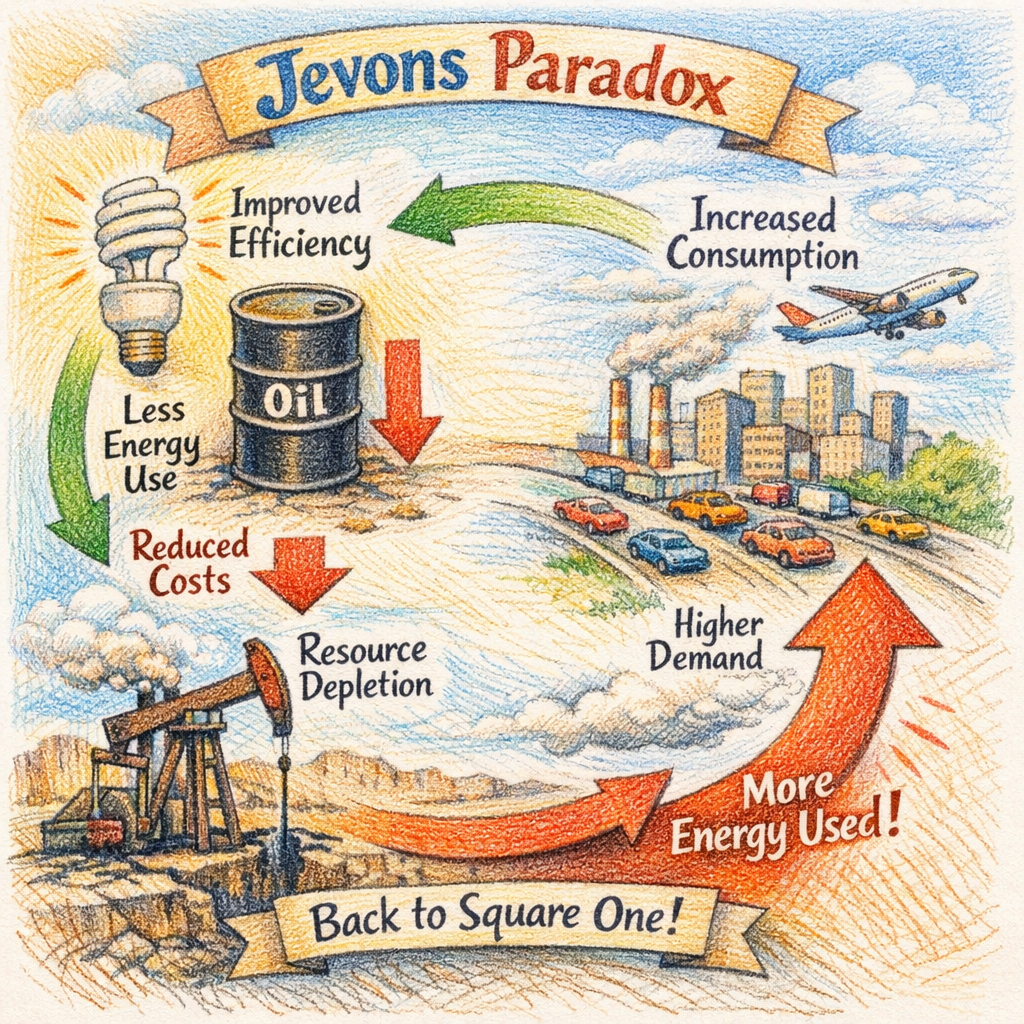
English VersionThe Jevons Paradox occurs when technological progress increases the efficiency with which a resource is used, but the falling cost of use induces so much new demand that total consumption rises rather than falls.
Historical BackgroundThis concept was introduced by economist William Stanley Jevons in 1865. He observed that James Watt’s improvements to the steam engine made coal a more cost-effective fuel, which led to the widespread adoption of steam power and ultimately increased total coal consumption in Britain.
The Rebound Effect- Direct Rebound: Improved efficiency lowers the relative cost of a service, encouraging increased usage.
- Indirect Rebound: Gains in efficiency allow consumers to spend their savings on other resource-intensive goods and services.
Modern Applications- LED Lighting: While LED bulbs are highly energy-efficient, the reduced cost of lighting has led to more extensive illumination in urban and residential areas.
- Data Storage: As storage efficiency improves, rather than saving space, we generate and store exponentially more high-resolution data.
728x90'손 가는 대로 > 그냥' 카테고리의 다른 글
출고 전 검사 (Pre-Dispatch Inspection, PDI) (0) 2026.04.01 Global News Update: April 1, 2026 (0) 2026.04.01 모라벡의 역설 (Moravec’s Paradox) (0) 2026.03.26 주요 심리학 기반 성격 평가 프로그램들 (0) 2026.03.20 개인정보관리사 (CPPG) (0) 2026.03.19