-
한국계 은행의 인도 진출 현황발 가는... [APAC]/[IN]인도 2026. 5. 12. 20:13728x90
한국계 은행의 인도 진출 현황
현재 인도는 세계에서 가장 빠르게 성장하는 주요 경제국 중 하나이며, 이에 따라 자동차, 전자, 철강 등 다양한 산업군의 한국 기업들이 대거 진출해 있습니다. 이들 기업의 현지 자금 조달을 지원하고 신흥 금융 시장을 개척하기 위해 한국의 주요 시중은행들 역시 인도에서 활발히 영업을 전개하고 있습니다.
주요 은행 및 진출 지역
* 신한은행:
1996년 한국계 은행 중 가장 먼저 인도에 진출했습니다. 뭄바이를 시작으로 뉴델리, 첸나이, 푸네, 아메다바드, 랑가레디 등 총 6개의 지점을 보유하여 한국계 은행 중 가장 광범위한 네트워크를 자랑합니다.
* 우리은행:
2012년 첸나이 지점을 시작으로 구루그람(델리 NCR), 뭄바이, 푸네 등 주요 산업 거점에 지점을 두고 꾸준히 외연을 확장하고 있습니다.
* KEB하나은행:
첸나이와 구루그람에 지점을 운영 중이며, 최근 뭄바이·데바나할리(벵갈루루 권역)까지 확대 중입니다. 현지 한국 기업뿐만 아니라 이들과 협력하는 인도 로컬 기업들을 대상으로 영업을 강화하고 있습니다.
* KB국민은행:
국민은행은 구루그람에 지점을 두고 있으며, 인도 시장 확대를 추진 중입니다.
* IBK기업은행 (Industrial Bank of Korea):
기업은행은 뉴델리에 지점을 두고 있으며, 한국 중소기업 지원 목적이 강한 은행으로, 인도 현지 한국 기업 대상 금융을 많이 합니다.
* NH농협은행:
농협은행은 비교적 최근인 2023년 노이다(Noida)에 지점을 개설하였습니다.
주요 특징
인도 내 한국계 은행들의 가장 큰 특징은 철저한 '기업 금융(B2B)' 중심의 수익 구조입니다. 현대자동차, 기아, 삼성전자, LG전자 등 인도에 대규모 제조 시설을 갖춘 한국 대기업과 수백 개의 동반 진출 협력사들을 대상으로 한 기업 대출, 무역 금융, 외환 거래, 송금 서비스가 주된 업무입니다.
- 삼성·현대차·LG 협력업체 대상 기업금융
- 무역금융
- 외환·송금
- 한국 기업 주재원 서비스
장점
1. 높은 이해도와 신속한 커뮤니케이션: 한국 비즈니스 문화와 본사-지사 간의 생리를 정확히 파악하고 있어, 인도 현지 은행들보다 훨씬 빠르고 유연한 의사결정과 맞춤형 금융 지원이 가능합니다.
2. 전략적 시너지: 첸나이(자동차), 노이다(전자) 등 한국 기업이 밀집한 산업 클러스터에 맞춤형으로 지점을 배치하여, 벤더(협력사) 기업들의 공급망 금융을 효과적으로 지원합니다.
단점 및 도전 과제
1. 제한된 소매 금융(Retail Banking): 인도 현지 개인 고객을 대상으로 한 대출이나 신용카드 등 리테일 금융 네트워크는 SBI, HDFC 등 인도의 거대 국내 은행들에 비해 매우 열세입니다.
2. 높은 규제 장벽: 인도 중앙은행(RBI)의 외국계 은행 지점 개설 인가 기준과 자본금 규제가 매우 까다로워, 물리적인 점포망 확대에 긴 시간과 큰 비용이 소요됩니다.
결론적으로, 인도 내 한국계 은행들은 든든한 한국 기업들의 성장세를 바탕으로 안정적인 수익을 내고 있으며, 향후 현지 기업 대출 및 디지털 금융 강화를 통해 '진정한 현지화'를 이루는 것이 다음 과제가 될 것입니다.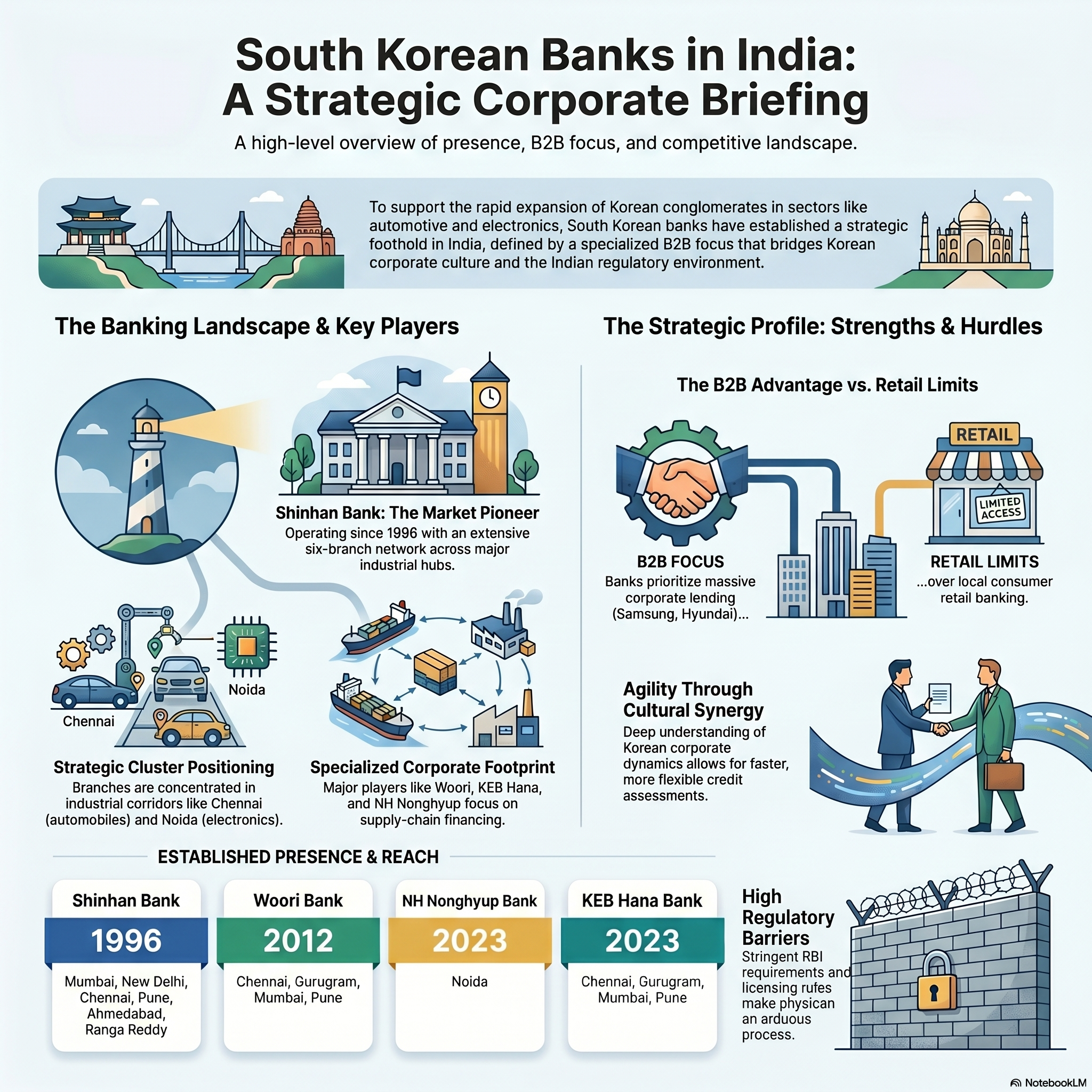
South Korean Banks in India
Good morning/afternoon. Today, I would like to brief you on the current landscape, characteristics, and strategic positioning of South Korean banks operating in India.
India is currently one of the fastest-growing major economies in the world. Consequently, numerous South Korean conglomerates across automotive, electronics, and steel sectors have established a strong presence there. To support their financial needs and tap into this emerging market, major South Korean commercial banks are actively operating within India.
Major Banks and Locations
* Shinhan Bank: The pioneer among Korean banks, establishing its presence in 1996. It boasts the most extensive network with six branches located in Mumbai, New Delhi, Chennai, Pune, Ahmedabad, and Ranga Reddy.
* Woori Bank: Starting with its Chennai branch in 2012, it has steadily expanded its footprint to key industrial hubs, including Gurugram (Delhi NCR), Mumbai, and Pune.
* KEB Hana Bank: Operates branches in Chennai and Gurugram, focusing not only on Korean expats but increasingly on Indian domestic companies that partner with Korean firms.
* KB Kookmin Bank, IBK (Industrial Bank of Korea), and NH Nonghyup Bank: KB operates in Gurugram and IBK in New Delhi. NH Nonghyup recently opened a branch in Noida in 2023. Each is leveraging its specialized corporate and commercial banking expertise to establish a solid foothold.
Key Characteristics
The most defining characteristic of these banks in India is their strict focus on corporate banking (B2B). Their primary operations revolve around corporate lending, trade finance, and foreign exchange services tailored for massive Korean conglomerates—such as Hyundai, Kia, Samsung, and LG—and their extensive networks of Tier 1 and Tier 2 suppliers operating in India.
Pros / Advantages
1. Deep Understanding and Agility: They possess an innate understanding of Korean business culture and the headquarters-subsidiary dynamic. This allows for significantly faster decision-making, flexible credit assessments, and tailored communication compared to local Indian banks.
2. Strategic Synergy: By strategically placing branches near major Korean industrial clusters (e.g., Chennai for automobiles, Noida for electronics), they highly effectively support the supply chain financing of partner companies.
Cons / Challenges
1. Limited Retail Banking Presence: Their network for retail banking (personal loans, credit cards, etc.) aimed at local Indian consumers is severely limited and cannot compete with giant domestic banks like SBI, HDFC, or ICICI.
2. High Regulatory Barriers: The Reserve Bank of India (RBI) imposes stringent regulations and capital requirements on foreign banks opening new branches. Consequently, physical expansion is a highly time-consuming and arduous process.
In conclusion, South Korean banks in India are generating stable revenues backed by the robust growth of Korean manufacturing in the region. Moving forward, their primary challenge will be achieving deeper "localization" by expanding their loan portfolios to pure Indian domestic corporations and enhancing digital banking platforms.728x90' 발 가는... [APAC] > [IN]인도' 카테고리의 다른 글
인도 델리의 주거용 임대 부동산 시장의 주요 범주 (0) 2026.05.11 인도 델리 NCR 부동산의 반전: 왜 모두가 외곽 신도시로 향하는가? (0) 2026.05.11 첸나이 국제공항 (MAA) (0) 2026.05.08 인디라 간디 국제공항 (DEL) (0) 2026.05.08 델리-NCR(수도권) 오피스 시장 서브 권역 (0) 2026.05.08