-
데이터 센터 폐열 활용 (Data Center Waste Heat Utilization / ERF)손 가는 대로/금융자산운용 2026. 6. 9. 07:05728x90
최근 인공지능(AI) 하이퍼스케일 데이터 센터의 폭발적인 확장과 전 세계적인 전력망 부족 사태가 맞물리면서, 전력 및 빅테크 업계 뉴스에 연일 등장하는 혁신적인 최신 친환경 트렌드 키워드는 바로 '에너지 재사용 계수 (ERF, Energy Reuse Factor)'와 연계된 '데이터 센터 폐열 격자망 (Data Center Waste Heat Grids)'입니다.
데이터 센터 폐열 활용 (Data Center Waste Heat Utilization / ERF)
그동안 데이터 센터의 친환경 수준을 평가할 때 가장 많이 쓰인 지표는 PUE(Power Usage Effectiveness, 전력 효율 지수)였습니다. 데이터 센터가 사용하는 총전력 중 'IT 장비 자체'에 전력이 얼마나 순수하게 들어가고, 냉각(Cooling)에 낭비되는 전력이 얼마나 적은지를 따지는 기준이었죠. 즉, 에너지를 얼마나 '덜 낭비하는가'에 초점이 맞춰져 있었습니다. 하지만 AI 시대에 진입하면서 수많은 그래픽처리장치(GPU)가 뿜어내는 열량이 상상을 초월하게 되었고, 이제는 단순히 열을 식히는 단계를 넘어 '발생한 열을 어떻게 가치 있게 재활용할 것인가'로 패러다임이 완전히 뒤바뀌고 있습니다. 이 재활용의 효율을 0에서 1 사이의 숫자로 나타낸 최신 지표가 바로 ERF입니다.
최근 유럽을 중심으로 한 최신 환경 규제 뉴스들을 보면, 데이터 센터를 지을 때 이 ERF 기준을 최소 10% 이상 달성하도록 법제화하는 움직임이 빠르게 확산되고 있습니다. 서버가 연산하면서 내뿜는 뜨거운 열(폐열)을 그대로 대기 중에 버리지 말고, 최소 10% 이상은 인근 지역사회나 다른 산업의 에너지원으로 강제 재사용하라는 뜻입니다.
실제로 구글이나 메타, 마이크로소프트 같은 기업들은 데이터 센터 옆에 대규모 스마트 팜(온실)을 지어 겨울철 농작물 재배용 난방수로 이 폐열을 공급하거나, 지역 난방 공사와 협력하여 인근 수만 가구의 아파트에 따뜻한 온수를 공급하는 이른바 '폐열 격자망(Waste Heat Grids)'을 구축하고 있습니다. 특히 최근 도입되고 있는 차세대 액체 냉각(Liquid Cooling) 기술은 열을 공기가 아닌 액체로 직접 흡수하기 때문에, 과거보다 훨씬 높은 온도의 폐열을 그대로 보존해 지역 난방에 바로 활용할 수 있게 해줍니다.
결국 데이터 센터 폐열 활용과 ERF는 단순한 친환경 캠페인이 아닙니다. 거대한 전력을 소비하는 데이터 센터가 지역사회의 탄소 배출을 획기적으로 줄여주는 '거대한 열 공급 발전소'의 역할까지 겸임하게 만드는, AI 인프라 확장을 위한 가장 영리하고 현실적인 상생 전략입니다.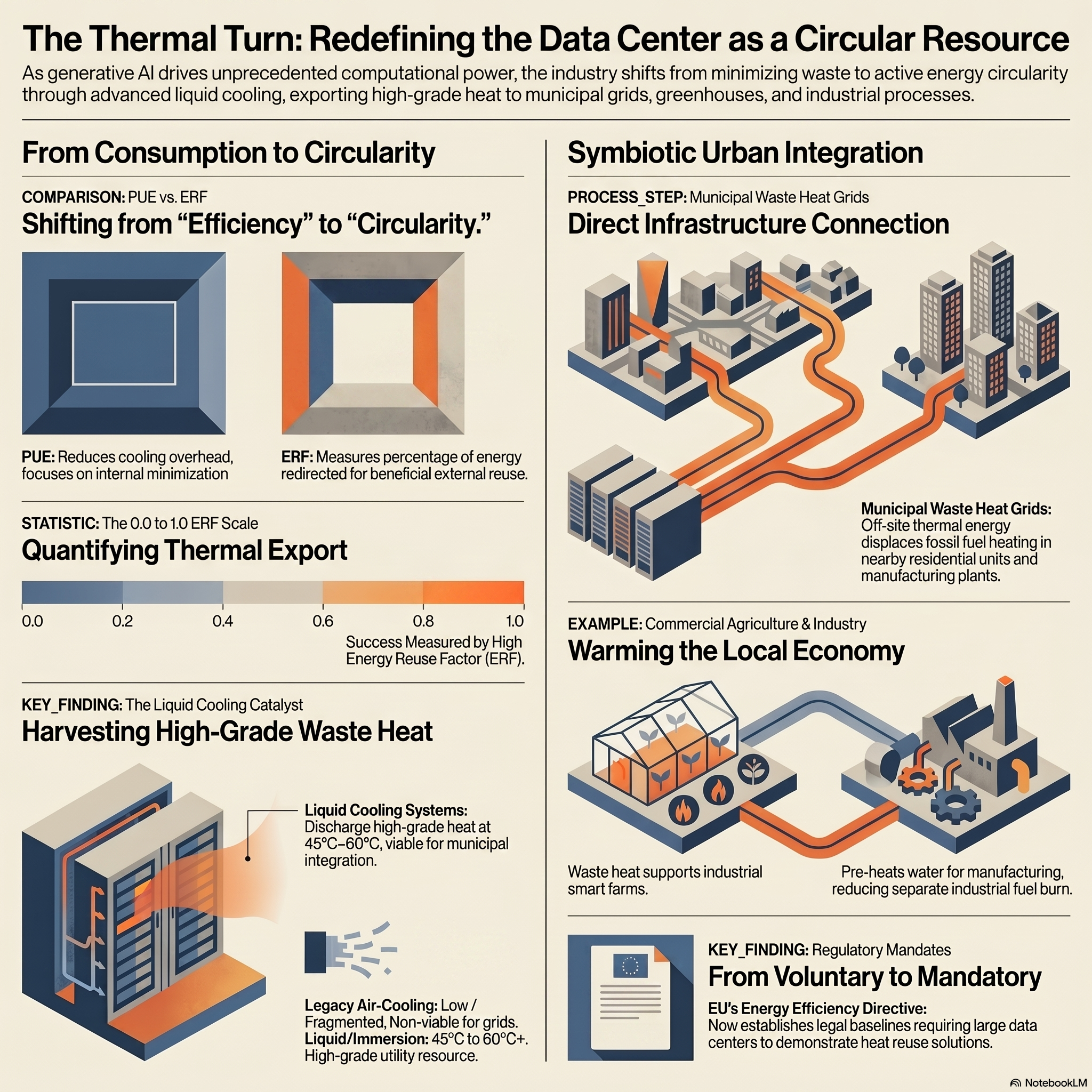
Data Center Waste Heat Utilization (ERF)
Hello. Today, I'd like to delve into a transformative sustainability metric and infrastructure trend that is taking center stage in global technology and energy news: Data Center Waste Heat Utilization and its governing index, the Energy Reuse Factor (ERF).
For decades, the universal gold standard for checking a data center's efficiency was PUE—Power Usage Effectiveness. PUE strictly measures how much energy goes into the actual computing servers versus how much is overhead, primarily spent on cooling. In short, PUE was all about 'minimizing waste.' However, in the era of Generative AI, where dense clusters of high-power GPUs generate unprecedented thermal loads, the industry is shifting from merely dissolving heat to aggressively repurposing it. This is where ERF comes into play. It calculates the exact ratio of energy a data center successfully redirects to external beneficial uses.
If you look at the recent regulatory updates, particularly coming out of the European Union, policymakers are beginning to mandate specific ERF targets—often requiring new facilities to achieve an ERF of at least 10%. This means data centers can no longer just vent their server exhaust into the atmosphere; they are legally bound to recover and export that thermal energy back to the local ecosystem.
To comply with this evolving mandate, hyperscalers like Microsoft, Meta, and Google are integrating their cooling loops with regional infrastructure through 'Waste Heat Grids.' The high-temperature fluid or air coming off the processing racks is being funneled to provide district heating for thousands of surrounding residential homes, or channeled directly into industrial-scale greenhouses to support year-round agricultural production. Furthermore, the rapid adoption of next-generation liquid cooling architectures captures this heat at much higher, more usable temperatures, making district utility integration far more thermodynamically viable.
Ultimately, maximizing ERF through waste heat utilization transforms the perception of a data center. It evolves the facility from being viewed purely as an insatiable energy drain on the community into a reliable, non-combustible thermal power plant that actively displaces fossil fuels in urban heating sectors.728x90'손 가는 대로 > 금융자산운용' 카테고리의 다른 글
GE 버노바 (GE Vernova Inc. | GEV:NYQ) (0) 2026.06.09 GARP (iShares MSCI USA Quality GARP ETF) (0) 2026.06.09 SMH (VanEck Semiconductor ETF) (0) 2026.06.08 BIZD (VanEck BDC Income ETF) (0) 2026.06.08 태양광 발전사업의 전 생애주기(Lifecycle) 관리 (0) 2026.06.05