-
2-3) RPS 일몰과 신설 제도: 현금 흐름의 대전환손 가는 대로/태양광 2026. 7. 10. 21:23728x90
안녕하십니까, 태양광 투자자 여러분. Chapter 2의 세 번째 순서로, 현재 대한민국 태양광 시장의 판도를 뒤흔들고 있는 정책 변화인 RPS 일몰과 신설 제도에 대해 아주 상세하고 전문적으로 설명해 드리겠습니다.
투자 시장에서 정책의 변화를 읽는 것은 곧 수익률을 지키는 것과 같습니다. 과거 태양광 투자의 핵심 기둥이었던 RPS 제도가 어떻게 저물어가고 있으며, 그 자리를 대신할 새로운 제도가 투자자분들에게 어떤 기회와 도전을 가져다줄지 깊이 있게 분석해 보겠습니다.
---
3) RPS 일몰과 신설 제도: 현금 흐름의 대전환
RPS 제도의 한계와 일몰 배경
먼저 RPS 즉, 신재생에너지 공급의무화 제도의 현재 상태를 진단해 볼 필요가 있습니다. 지난 10여 년간 RPS 제도는 대한민국의 신재생에너지 보급을 이끈 핵심 엔진이었습니다. 대형 발전사들에게 의무 공급량을 할당하고, 이를 채우기 위해 민간 발전사업자들로부터 REC 즉, 신재생에너지 공급인증서를 구매하도록 한 제도입니다.
투자자분들은 전력을 판매한 대가인 SMP와 환경 가치를 인정받은 REC라는 두 가지 현금 흐름을 통해 수익을 창출해 왔습니다. 하지만 이 제도는 치명적인 한계를 드러냈습니다.
가장 큰 문제는 REC 가격의 극심한 변동성입니다. 정부가 의무 공급 비율을 조정하거나, 시장에 패널 공급이 일시에 몰릴 경우 REC 가격은 폭락했습니다. 안정적인 이자 수익을 기대하고 들어온 은퇴 세대 투자자들에게 이러한 변동성은 감당하기 힘든 리스크였습니다. 또한, REC를 구매해야 하는 의무 발전사들의 비용 부담이 커지면서 이는 결국 공기업인 한국전력의 적자 가속화와 전기요금 인상 압박으로 이어졌습니다.
이에 정부는 작년부터 RPS 제도를 근본적으로 개편하거나 사실상 일몰하고, 보다 시장 친화적이고 안정적인 제도로 전환하겠다는 신호를 명확히 보냈습니다. 이는 산업통상자원부의 제10차 전력수급기본계획 등에서 이미 예고된 바 있으며, 최근 법적 근거 마련에 속도를 내고 있습니다.
신설 제도의 핵심: 경쟁 입찰과 고정 가격
그렇다면 RPS가 떠난 자리에 무엇이 들어올까요. 정부가 추진하는 새로운 제도의 핵심은 크게 경쟁 입찰과 고정 가격 계약의 중앙 집중화로 요약할 수 있습니다.
과거에도 고정가격계약 경쟁입찰이 존재했지만, 이는 RPS라는 큰 틀 안에서 하나의 정산 방식에 불과했습니다. 하지만 신설되는 제도는 태양광 발전사가 생산한 전력에 대해 정부가 일정한 가격으로 20년간 구매를 보장하되, 그 가격을 시장 경쟁을 통해 결정하겠다는 것입니다.
이는 해외 선진국들에서 이미 시행 중인 경매 제도와 유사합니다. 정부가 매년 필요로 하는 태양광 물량을 공고하면, 투자자들은 자신이 발전소를 운영할 수 있는 가장 낮은 가격을 투찰합니다. 가장 낮은 가격을 제시한 사업자부터 낙찰을 받게 되며, 이 가격으로 20년간 안정적인 수익을 확보하게 됩니다.
투자자가 체감할 변화의 예시
이 변화가 투자자분들에게 미치는 영향을 아주 구체적인 예시로 비교해 보겠습니다.
과거 RPS 현물시장 기반 투자자 Case
100킬로와트 규모의 태양광 발전소를 운영하는 A씨가 있다고 가정해 봅니다. A씨는 SMP와 REC를 현물시장에서 매달 판매합니다. 어떤 달은 국제 유가 상승으로 SMP가 폭등하여 큰 수익을 냅니다. 하지만 다음 달에는 갑작스러운 정책 발표로 REC 물량이 쏟아지며 REC 가격이 반토막 납니다. A씨의 매월 현금 흐름은 요동치며, 대출 원리금을 갚는 데 애를 먹는 달도 발생합니다. 이는 투자가 아니라 투기에 가까운 스트레스를 유발합니다.
신설 경쟁 입찰 기반 투자자 Case
동일한 규모의 발전소를 준비하는 B씨가 있습니다. B씨는 정부가 실시하는 경쟁 입찰에 참여합니다. B씨는 철저한 비용 분석을 통해 킬로와트시당 150원을 투찰하여 낙찰받았습니다. 이제 B씨는 SMP 가격이 폭락하든, REC라는 개념이 사라지든 상관없이, 향후 20년간 자신이 생산한 모든 전력에 대해 킬로와트시당 150원을 보장받습니다. 매월 현금 흐름은 완벽하게 예측 가능해지며, 이를 바탕으로 안정적인 자금 계획을 수립하고 저금리 대출을 활용할 수도 있습니다.
결론: 안정적 자산으로의 회귀
결론적으로 RPS의 일몰과 신설 제도의 도입은 태양광 투자를 변동성이 큰 주식형 자산에서, 예측 가능한 채권형 자산으로 성격을 규정짓는 대전환입니다.
투자자분들은 더 이상 REC 가격의 등락에 일희일비할 필요가 없습니다. 대신, 어떻게 하면 발전소 건설 비용과 운영 비용을 낮추어 경쟁력 있는 가격으로 낙찰받을 것인가에 집중해야 합니다. 또한, 20년간 원만하게 계약을 이행할 수 있는 우량한 시공사와 운영사를 선정하는 안목이 수익률을 결정하는 핵심 지표가 될 것입니다.
변화는 두렵지만, 이번 정책 변화는 장기 투자자들에게는 오히려 시장의 투명성과 안정성을 높여주는 호재가 될 수 있음을 명심하시기 바랍니다.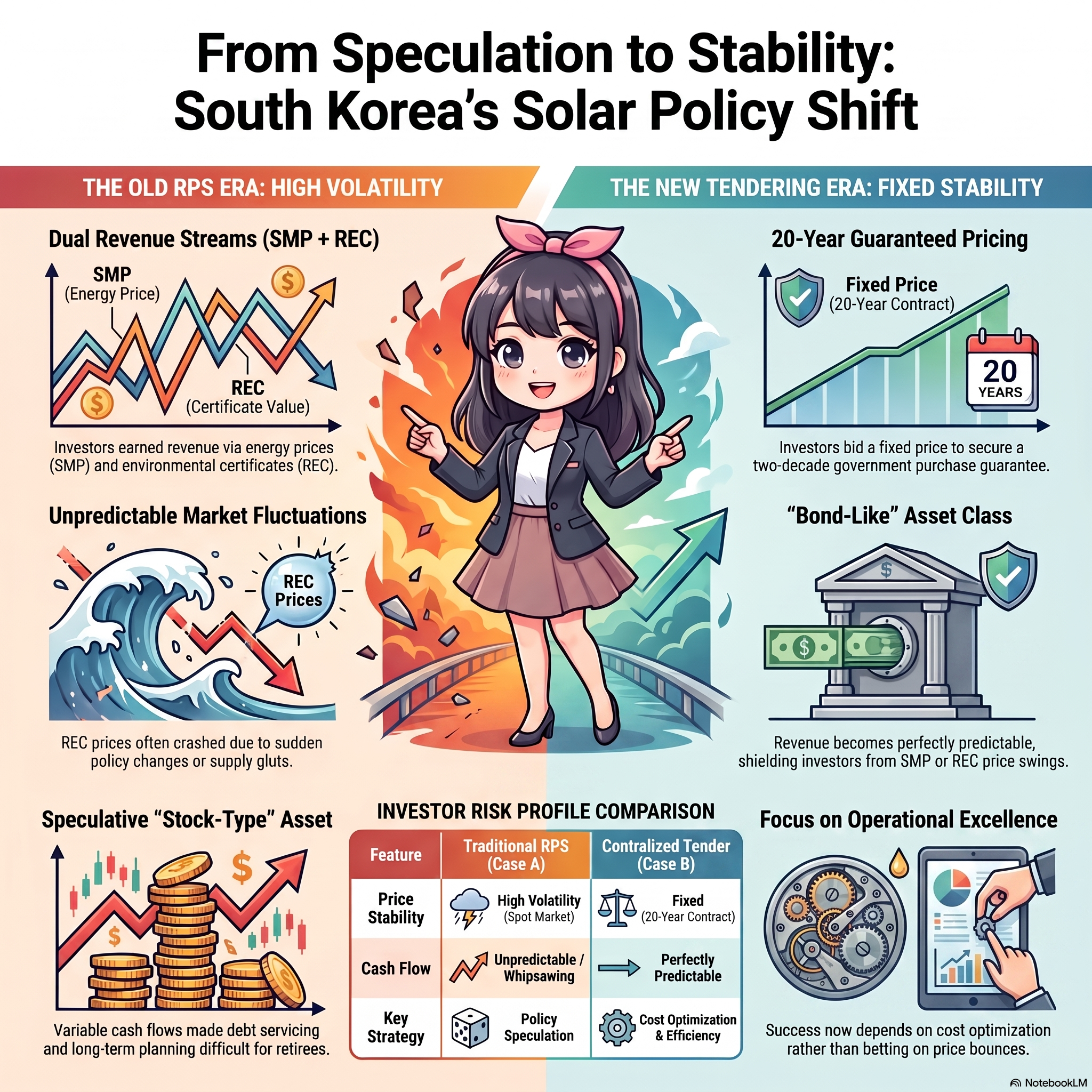
---
Chapter 2. Solar Power, How to Make It Profitable
3) Post-RPS Landscape and New Regulatory Models
Hello, fellow solar investors. As we continue Chapter 2, we must address the most significant regulatory pivot currently reshaping the South Korean solar market: the transition away from the RPS system and the rise of new mechanism.
In solar investment, policy literacy is directly correlated with risk management and returns. We will analyze the decline of the long-standing Renewable Portfolio Standard (RPS) and provide a deep dive into the new central centralized tendering models that will soon dictate cash flows in this sector.
---
The Sunset of RPS: Root Causes and Strategic Shifts
Understanding the post-RPS landscape requires recognizing why the original system became unsustainable. For over a decade, the Renewable Portfolio Standard (RPS) acted as the primary driver of South Korea's renewable growth. It mandated that large-scale utility generators meet specific renewable quotas, forcing them to purchase Renewable Energy Certificates (RECs) from smaller, independent power producers.
For investors, this structure generated a dual revenue stream: the System Marginal Price (SMP) from energy sales and the REC price from environmental attributes. However, this model exhibited critical flaws that policy makers could no longer ignore.
The foremost issue was the extreme volatility of REC pricing. Spot market prices were hyper-sensitive to policy adjustments and supply gluts, causing sudden crashes. For investors seeking stable, annuity-like income—many of whom are retirees—this volatility was an unmanageable risk. Furthermore, the rising cost of REC procurement placed immense financial strain on obligated utility firms, accelerating the deficit of the state-owned utility, KEPCO, and exerting upward pressure on consumer electricity rates.
Consequentially, the Ministry of Trade, Industry and Energy (MOTIE) has signaled a clear strategic departure. The policy trend is now focused on phasing out the chaotic REC spot market in favor of a more structured, market-centric, and cost-efficient mechanism, a direction already encoded in South Korea's 10th Basic Plan for Electricity Supply and Demand.
The Rise of Centralized Tenders and Levelized Revenues
What exactly replaces the RPS? The cornerstone of the emerging regulatory model is the shift toward centralized competitive tendering, focusing on long-term, fixed-price contracts.
While competitive bidding for fixed-price contracts existed as a carve-out within RPS, the new model aims to make this the default. The core principle is that the government or a centralized entity will guarantee the procurement of solar power for 20 years at a specific price, but that price will be determined through market competition rather than administrative fiat.
This closely mirrors the reverse auction mechanisms widely utilized in leading global renewable markets. MOTIE will announce an annual volume of solar capacity it intends to procure. Prospective investors will then submit bids detailing the lowest price at which they can operate their project. The lowest bidders are awarded the 20-year contracts, ensuring a levelized revenue stream for two decades.
Investor Implications: Shift in Revenue Risk Modeling
To make this tangible, let us compare the risk profiles of investors under the old and new regimes.
Case A: The Traditional RPS Spot Market Investor
Imagine an investor operating a 100kW plant under the traditional model. They sell SMP and REC monthly on the spot markets. In a month when global oil prices spike, their SMP revenue surges, creating a profit windfall. However, the next month, a policy announcement floods the market with REC supply, causing REC prices to drop by 50%. Their monthly cash flow whipsaws. This volatility resembles a speculative stock portfolio, creating anxiety and making long-term debt servicing calculations highly unreliable.
Case B: The New Centralized Tender Investor
Consider another investor planning a similar 100kW plant under the centralized tendering model. They participate in the government auction. After rigorous cost analysis, they submit a bid of 150 KRW per kWh and are awarded the contract. For the next 20 years, they are guaranteed 150 KRW for every kWh they produce, regardless of how drastically SMP fluctuates or if the very concept of RECs is eliminated. Their monthly cash flow is perfectly predictable, enabling them to secure low-interest project financing and draft precise long-term asset management plans.
Conclusion: The Era of Policy-Backed Annuities
Ultimately, the transition from RPS to a centralized tendering model represents the redefinition of solar assets from high-volatility, equity-like instruments to predictable, infrastructure-grade bond-like assets.
Investors must shift their focus from policy speculation—betting on REC price bounces—to operational excellence. Success in the post-RPS era depends entirely on cost optimization to secure a competitive bid. Selecting high-quality Engineering, Procurement, and Construction (EPC) firms and Operation and Maintenance (O&M) partners capable of maintaining long-term project performance at a low cost becomes the primary driver of investment returns. Policy stability, rather than policy speculation, is the new normal.728x90'손 가는 대로 > 태양광' 카테고리의 다른 글
2-5) SMP+REC와 PPA, 내 발전소에는 어떤 방식이 유리할까? (0) 2026.07.13 2-4) RE100 시대의 새로운 수익 모델: 직접 PPA(전력구매계약) 란 무엇인가? (0) 2026.07.13 2-2) 핵심 개념 잡기: SMP(계통한계가격)와 REC(신재생에너지 공급인증서)의 이해 (0) 2026.07.10 2-1) 태양광 발전의 기본 작동 원리 (0) 2026.07.09 1-2) 글로벌 RE100 트렌드와 기업들의 의무 (0) 2026.07.08