-
3-1) 매월 들어오는 제2의 월급 (연금형 수익 모델)손 가는 대로/태양광 2026. 7. 14. 08:40728x90
3장. 태양광 투자의 3가지 매력
1) 매월 들어오는 제2의 월급 (연금형 수익 모델)
오늘은 태양광 발전 사업이 가진 여러 장점 중에서도 가장 핵심적이고 직관적인 매력인 '매월 들어오는 제2의 월급, 연금형 수익 모델'에 대해 더욱 깊이 있게 설명해 드리겠습니다.
다른 투자 자산과 비교할 때 태양광 투자가 가진 가장 큰 차별점은 현금 흐름의 예측 가능성과 운영의 편의성입니다.
공실 걱정, 세입자 스트레스가 없는 완벽한 임대 사업
부동산 임대업은 훌륭한 투자처이지만, 그 이면에는 무시할 수 없는 스트레스가 존재합니다. 세입자를 구하기 위해 부동산을 돌아다녀야 하고, 중개 수수료가 발생하며, 행여나 공실이 발생하면 그달의 수익은 0원이 됩니다. 건물 노후화로 인한 누수나 보일러 고장 등 세입자의 민원도 끊임없이 해결해야 합니다.
하지만 태양광 발전 사업은 '한국전력공사'와 '발전 자회사'라는 국가 주도의 초우량 기업을 단일 세입자로 두는 완벽한 임대 사업입니다. 전기를 생산하기만 하면 송전망을 통해 자동으로 납품되며, 국가 기관이 전력을 사가기 때문에 악성 미납이나 공실 위험이 제로(0)에 가깝습니다. 세입자와 얼굴을 붉히며 월세를 독촉할 일도, 새로운 세입자를 찾기 위해 발품을 팔 필요도 없는 가장 깔끔한 형태의 임대 수익 모델입니다.
날씨는 배신하지 않는다: 20년 장기 고정가격계약이 주는 압도적 안정성
주식이나 코인 시장은 매일 변동하는 차트 앞에서 투자자의 마음을 졸이게 합니다. 반면, 태양광 투자의 기본 수익원은 매일 아침 떠오르는 태양입니다. 하루하루의 날씨는 흐릴 수도 맑을 수도 있지만, 1년이라는 주기로 평균을 내어보면 일조량은 거의 일정하게 유지됩니다.
여기에 '고정가격계약 경쟁입찰' 제도가 더해지면 수익의 안정성은 극대화됩니다. 이 제도를 활용하면 생산한 전력(SMP)과 신재생에너지 공급인증서(REC)를 합산한 가격을 향후 20년 동안 고정하여 계약을 맺을 수 있습니다. 글로벌 에너지 위기나 화석 연료 가격의 급등락 속에서도, 내 발전소의 전력 판매 단가는 외부 충격으로부터 철저히 보호받습니다. 날씨의 정직함과 국가 제도가 결합하여 20년간 변치 않는 압도적인 안정성을 제공하는 것입니다.
구체적인 예시를 들어 수익 구조를 살펴보겠습니다.
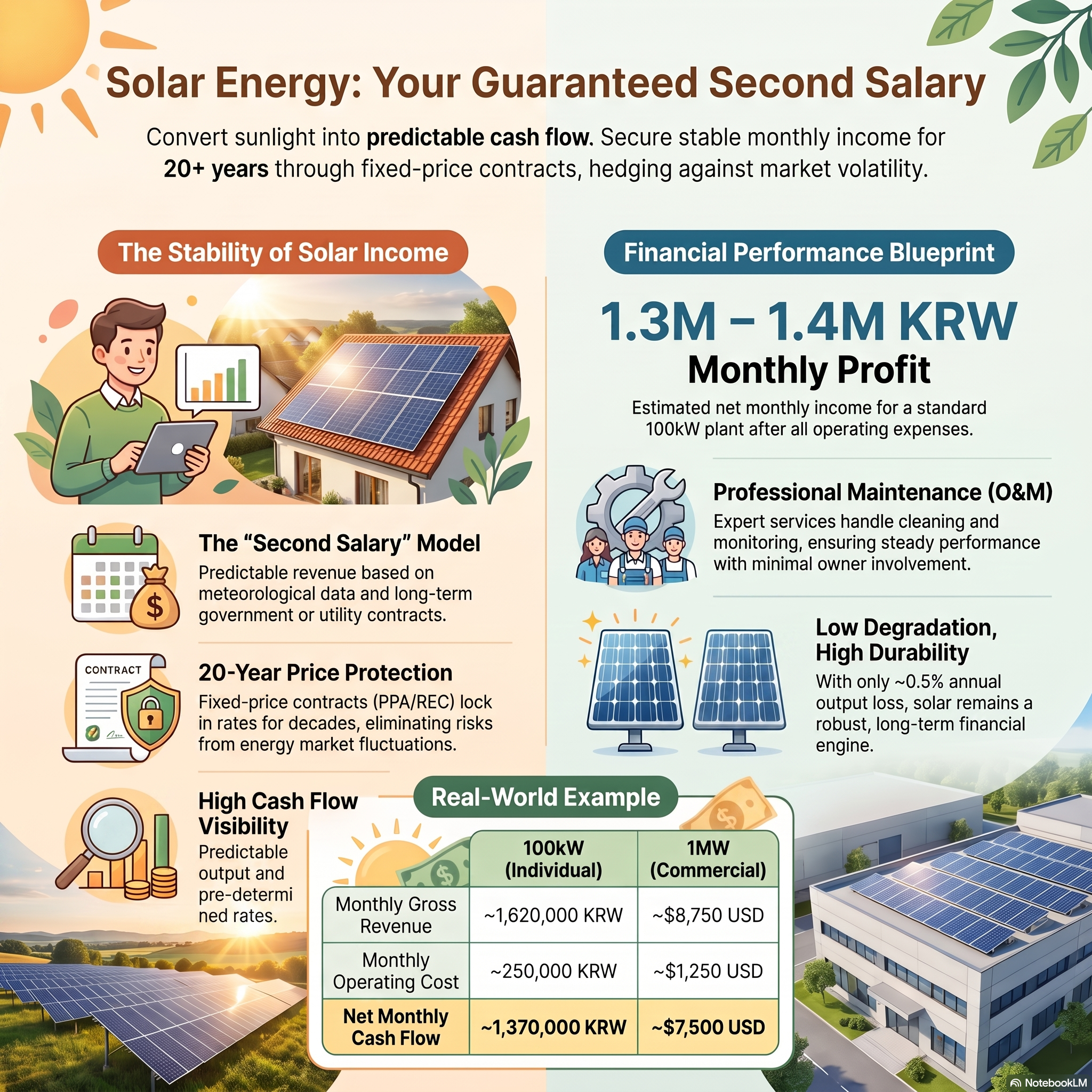
설비 용량 100kW 규모의 태양광 발전소를 운영한다고 가정해 보겠습니다. 대한민국의 연평균 하루 발전 시간을 보수적으로 3.6시간으로 잡으면, 한 달(30일 기준) 평균 발전량은 10,800kWh가 됩니다. 만약 고정가격계약을 통해 kWh당 150원의 단가를 확보했다면, 매월 발생하는 총매출은 1,620,000원이 됩니다.
본업을 유지하면서 투잡이 가능한 '반자동화' 수익 시스템
태양광 발전소는 스스로 전기를 생산하고 판매하는 훌륭한 반자동화 시스템입니다.
발전소 운영을 위해서는 안전관리자 선임, 인터넷 통신비, 보험료, 부지 임대료, 유지보수(O&M) 등 매월 고정 운영비가 발생합니다. 100kW 기준으로 월 대략 20만 원에서 30만 원 선입니다. 앞서 계산한 매출에서 이를 공제하면 매월 약 130만 원에서 140만 원의 순수익이 발생합니다.
여기서 중요한 점은 이 수익을 창출하기 위해 사업주가 현장에 상주할 필요가 없다는 것입니다. 태양광 패널은 물리적으로 움직이는 부품(Moving Parts)이 없어 기계적 고장이 적습니다. 현장 관리는 전문 O&M 업체에 위탁하고, 사업주는 스마트폰 모니터링 앱을 통해 발전량이 정상적으로 찍히는지만 확인하면 됩니다. 직장인이나 자영업자분들이 본업을 유지하면서도 무리 없이 병행할 수 있는 최고의 투잡 모델인 이유가 바로 여기에 있습니다.
결론적으로 태양광 발전 사업은 세입자 스트레스가 없고, 20년간 수익이 확정되며, 내 시간과 노동력을 최소화할 수 있는 자산입니다. 초기 투자금 조달 시 금융권 대출을 이용하더라도, 매월 들어오는 안정적인 수익으로 원리금을 상환하고 남은 금액을 고정적으로 확보할 수 있습니다. 은퇴 후 국민연금 외에 확실한 현금 흐름을 보장해 주는 가장 든든한 '제2의 월급 통장'이 되어줄 것입니다.
---
Today, I will walk you through one of the most compelling financial attributes of commercial solar investments: the creation of a predictable, annuity-like revenue stream that serves as a highly reliable monthly paycheck.
When evaluating alternative asset classes, sophisticated investors prioritize visibility of cash flows and ease of management. Solar infrastructure excels on both fronts, fundamentally transforming how passive income is generated.
The Ultimate Rental Property: Zero Vacancy and No Tenant Headaches
Real estate investment is a traditional path to wealth, but it comes with intense management burdens. Landlords face the constant stress of tenant turnover, vacancy periods that drop monthly yields to zero, broker fees, and endless maintenance calls for broken appliances.
A solar power plant operates much like a commercial rental property, but with a flawless tenant. Once your system is interconnected to the grid, your sole "tenant" is a highly creditworthy utility company or a large multinational corporation. The energy you produce is automatically delivered to the grid, and you are compensated directly. There are no tenants to chase for late rent, no evictions, and absolutely no vacancy risk. As long as the sun shines, your asset is fully occupied and generating capital.
The Sun Never Betrays: Unmatched Stability Through 20-Year PPAs
Financial markets are famously volatile, leaving investors vulnerable to macroeconomic shocks. Solar revenue, however, is anchored by meteorology and contractual law. While daily weather can fluctuate, long-term solar irradiance data is incredibly consistent year over year.
This meteorological reliability is financially secured through long-term Power Purchase Agreements (PPAs) or Feed-in Tariffs (FITs). By signing a PPA, you lock in a predetermined, fixed rate for the electricity your plant generates for the next 15 to 25 years. Whether global natural gas prices soar or energy markets crash, your wholesale rate remains completely untouched. You are effectively acquiring an asset insulated from inflation and market turbulence, backed by the undeniable consistency of the sun.
Let us examine a concrete commercial-scale example. Consider a 1 MW commercial solar installation in a high-irradiance region like California or southern Spain. We can reasonably project an annual energy yield of 1,500,000 kWh. If the project secures a Corporate PPA at a fixed rate of $0.07 per kWh for 20 years, the gross annual revenue is mathematically fixed at $105,000, which translates to an average monthly gross income of $8,750.
A Semi-Automated System Tailored for Busy Professionals
Perhaps the most attractive feature of a solar asset is its operational passivity. Unlike operating a franchise or managing real estate, solar arrays have virtually no moving parts, meaning mechanical wear and tear is minimal.
To maintain the plant, owners contract professional Operations and Maintenance (O&M) firms. For our 1 MW plant example, an O&M package covering regular cleaning, inverter servicing, insurance, and performance monitoring typically costs around $15,000 per year, or $1,250 per month. Subtracting this from the gross revenue leaves a robust net monthly cash flow of $7,500.
Because the day-to-day physical management is entirely outsourced, the asset owner’s role is reduced to simply checking a monitoring dashboard via a smartphone app. This creates a powerful "semi-automated" revenue system. It allows busy executives, business owners, and professionals to build substantial secondary income streams without compromising focus on their primary careers.
In summary, investing in solar energy is a highly structural financial strategy. You are bypassing tenant drama, securing your returns with a 20-year contractual safety net, and building a low-touch asset. It is not just an environmental statement; it is a meticulously designed financial instrument that converts sunlight into a fixed monthly pension for decades.728x90'손 가는 대로 > 태양광' 카테고리의 다른 글
3-3) 정부 지원 제도와 세제 혜택 (0) 2026.07.15 3-2) 친환경 ESG 투자의 자부심 (0) 2026.07.15 2-5) SMP+REC와 PPA, 내 발전소에는 어떤 방식이 유리할까? (0) 2026.07.13 2-4) RE100 시대의 새로운 수익 모델: 직접 PPA(전력구매계약) 란 무엇인가? (0) 2026.07.13 2-3) RPS 일몰과 신설 제도: 현금 흐름의 대전환 (0) 2026.07.10