-
6-3) 농어촌의 새로운 수익 모델: 영농형 vs 염해농지형손 가는 대로/태양광 2026. 7. 29. 08:12728x90
6장 내 이름으로 된 발전소 갖기: 어디에 어떻게 지을까?
3) 농어촌의 새로운 수익 모델: 영농형 vs 염해농지형
태양광 투자 A to Z의 6장 "내 이름으로 된 발전소 갖기: 어디에 어떻게 지을까?" 중 세 번째 주제인 "3) 농어촌의 새로운 수익 모델: 영농형 vs 염해농지형"입니다.
---
태양광 투자를 고려하실 때, 건물 지붕이나 일반 임야 외에도 최근 농어촌 지역을 중심으로 새롭게 떠오르는 투자 모델이 있습니다. 바로 농지라는 한정된 자원을 효율적으로 활용하면서 태양광 수익을 창출하는 '영농형 태양광'과 '염해농지형 태양광'입니다.
두 방식 모두 농촌의 수익 증대와 재생에너지 보급이라는 목적을 공유하지만, 투자 조건과 수익 구조에서 큰 차이가 있습니다. 최근 2026년 관련 법안이 제정 및 개정되면서 투자 환경이 급변하고 있으니 주목해 보시기 바랍니다.
1. 영농형 태양광: 농사와 발전을 동시에 (Agrivoltaics)
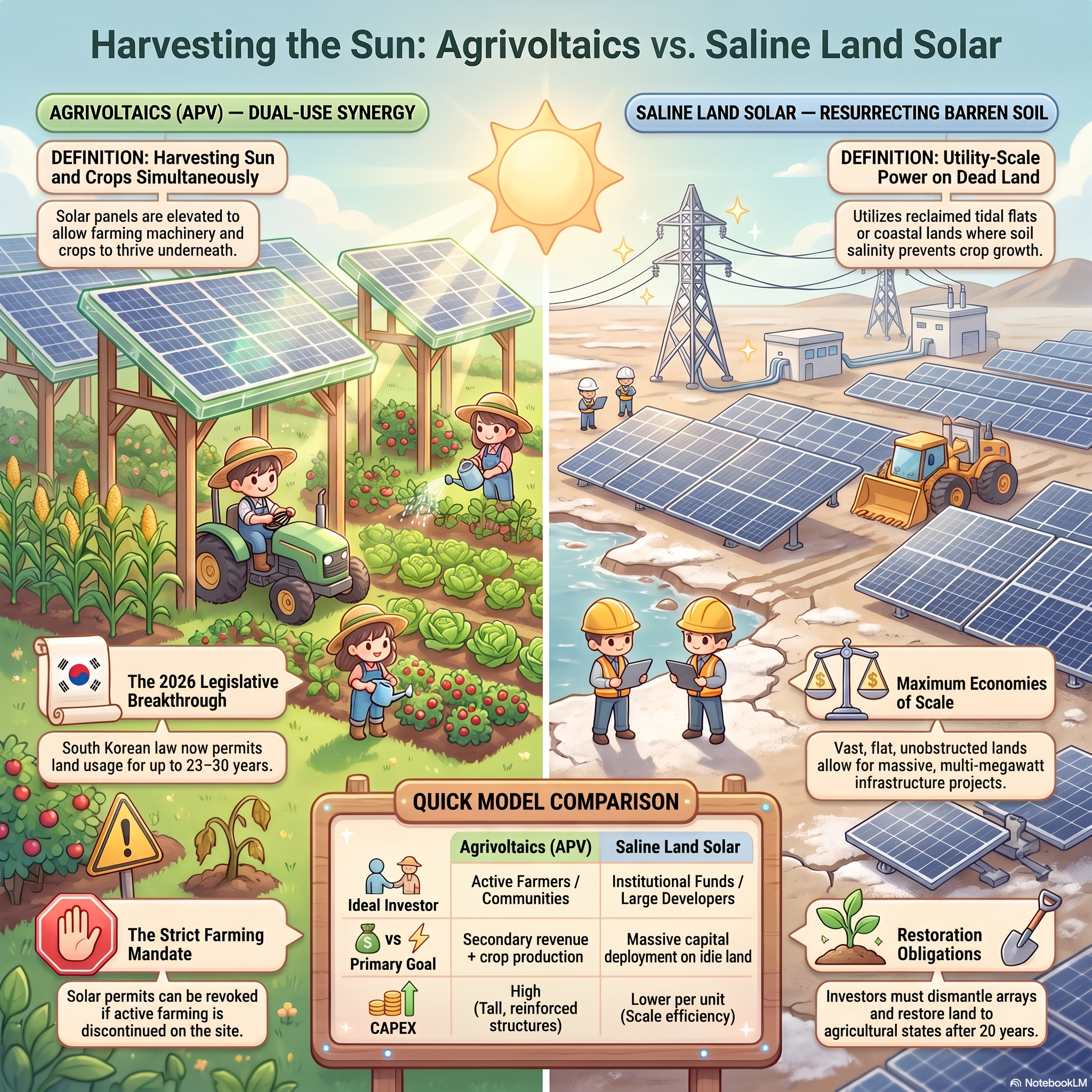
영농형 태양광은 쉽게 말해 '논밭 위에 지지대를 세워 지붕처럼 태양광 패널을 올리고, 그 아래에서는 원래대로 농사를 짓는 방식'입니다.
투자 강점 (농지 보존과 이중 수익): 기존의 농촌 태양광은 땅을 엎고 패널만 빽빽하게 깔아 농지가 훼손되는 문제가 있었습니다. 반면 영농형은 농사도 짓고 전기도 생산하는 '이모작' 구조입니다. 농민 입장에서는 농작물 판매 수익에 전력 판매 수익이 더해져 소득이 크게 늘어납니다. 최근 유럽연합(EU)에서도 농지 면적의 1%만 영농형 태양광으로 덮어도 약 950GW의 전력을 생산할 수 있다며 강력하게 밀고 있는 차세대 모델입니다.
2026년 법제화에 따른 폭발적 성장 기대: 대한민국에서는 2026년 5월, 이른바 '영농형 태양광법'이 국회를 통과하면서 거대한 투자 전환점을 맞았습니다. 과거에는 타용도 일시사용 허가 기간이 최장 8년에 불과해 태양광 투자비(통상 15~20년 회수)를 회수하기 불가능했습니다. 하지만 이번 법안 통과로 사용 기간이 최장 23년~30년까지 연장되었고, 심지어 우량 농지인 '농업진흥구역' 내에서도 예외적으로 설치가 가능해져 사업성이 대폭 개선되었습니다.
투자 시 주의사항 (설치비와 영농 의무): 농기계(트랙터 등)가 그 아래로 지나다녀야 하므로 일반 토지형보다 지지대를 훨씬 높고 튼튼하게 세워야 합니다. 패널 간격도 넓혀야 해서 단위 면적당 발전량이 15~30% 정도 낮고, 초기 설치비용(CAPEX)도 비쌉니다. 가장 주의할 점은 '엄격한 영농 의무'입니다. 발전만 하고 농사를 짓지 않는 이른바 '가짜 농민'을 막기 위해, 농업 활동을 지속하지 않으면 발전 사업 허가가 취소될 수 있는 강력한 페널티 조항이 있습니다.
2. 염해농지형 태양광: 버려진 땅의 화려한 부활
염해농지형 태양광은 바다를 메워 만든 간척지 중에서 땅에 소금기(염분)가 너무 많아 농사가 도저히 안 되는 이른바 '염해 농지'에 태양광 발전소를 짓는 방식입니다.
투자 강점 (대규모 개발과 유휴 부지 활용): 염해농지는 보통 수십, 수백만 평 단위로 뻗어 있는 거대한 간척지입니다. 벼농사를 지어도 수확량이 형편없는 쓸모없는 땅이었지만, 이곳을 20년간 임대하여 대규모 태양광 단지로 바꾸면 막대한 수익을 창출할 수 있습니다. 지형이 평탄하고 장애물이 없어 공사가 쉽고, 대규모(메가와트급)로 건설하기 때문에 규모의 경제를 확실하게 누릴 수 있습니다.
투자 시 주의사항 (엄격한 염도 기준과 기간 만료 리스크): 아무 땅이나 염해농지로 인정받는 것이 아닙니다. 정부 기관(한국농어촌공사 등)이 토양의 염도를 꼼꼼히 측정하여 일정 기준치를 초과해야만 태양광 허가를 받을 수 있습니다. 또한, 이 역시 농지를 잠시 다른 용도로 쓰는 '일시사용' 허가를 받는 것이므로, 20년의 사용 기간이 끝나면 태양광 시설을 모두 철거하고 다시 농지로 원상복구해야 한다는 강력한 의무가 있습니다.
구체적 예시: 전라남도나 충청남도의 거대한 간척지 주변에 거주하는 주민들이 협동조합을 만들어 염해농지 태양광 프로젝트에 지분 투자를 하기도 합니다. 농사로는 1년에 수백만 원도 못 벌던 땅에서, 태양광 임대료 및 발전 수익으로 수천만 원의 이익을 얻으며 지역 사회의 큰 환영을 받는 성공 사례가 늘고 있습니다.
3. 요약: 영농형 vs 염해농지형, 나의 선택은?
영농형 태양광은 본인이 직접 농사를 짓고 있는 농민이거나, 마을 공동체와 협력하여 농지 훼손 없이 지속가능한 추가 수익을 원하는 투자자에게 적합합니다. 2026년 신규 법안 통과로 인해 향후 가장 활발하게 펀딩이 일어날 분야입니다.
반면 염해농지형 태양광은 대규모 자본을 동원하여 간척지 등에 거대한 발전 단지를 조성하고, 압도적인 규모의 경제를 통해 수익을 극대화하려는 발전 사업자나 펀드 투자자에게 매력적인 선택지입니다.
---
New Revenue Models in Rural Areas: Agrivoltaics vs. Saline Land Solar
Now that we have discussed traditional site selection, let us explore two innovative models rapidly gaining traction in rural areas: Agrivoltaics and Saline Land Solar.
Both methods share the goal of increasing rural incomes and expanding renewable energy while utilizing agricultural land efficiently. However, they differ significantly in their operational structures and investment conditions. With sweeping legislative changes enacted in 2026, the investment landscape for these models has shifted dramatically.
1. Agrivoltaics (APV): Harvesting Sun and Crops Simultaneously
Agrivoltaics (APV) is the dual-use of land for both agriculture and solar energy generation. It involves mounting solar panels on elevated structures high enough above the ground to allow crops to grow and farming machinery to operate underneath.
The Investment Strength (Preserving Land, Doubling Income): Traditional ground-mounted solar often requires clear-cutting land, displacing agricultural output. Agrivoltaics solves this "food versus fuel" dilemma. For rural stakeholders, it provides a stable, predictable, and highly lucrative secondary income stream (electricity sales) layered on top of traditional crop revenues. Recent studies show that dedicating just 1% of agricultural land in the EU to APV could generate nearly 950 GW of solar capacity, making it a critical next-generation model.
The 2026 Legislative Breakthrough: In South Korea, the investment feasibility of APV was completely transformed in May 2026 with the passage of the "Agrivoltaics Act." Previously, agricultural land could only be temporarily repurposed for solar for a maximum of 8 years—far too short to recover a 20-year solar investment. The new 2026 legislation extended this permitted usage period to up to 23–30 years. Furthermore, it exceptionally permitted APV installations even in strictly protected "Agricultural Promotion Zones" (prime farmland), drastically opening up the market.
Investment Caveats (High CAPEX and Farming Mandates): Because the mounting structures must be significantly taller and stronger to accommodate tractors, the initial Capital Expenditure (CAPEX) is noticeably higher than standard solar. Panels must also be spaced further apart to allow sunlight to reach the crops, which can reduce energy density per acre by 15-30%. Crucially, the 2026 law imposes a strict "Farming Mandate." If an investor stops farming and uses the land solely for power generation (the so-called "fake farmer" issue), the government can revoke the solar permit. Active, verifiable agricultural production is legally required.
2. Saline Land Solar: Resurrecting Barren Soil
Saline Land Solar refers to utility-scale solar projects built on reclaimed tidal flats or coastal lands where the soil salinity is too high to grow crops viably.
The Investment Strength (Utility-Scale on Dead Land): Reclaimed saline lands are typically vast, flat, and entirely unobstructed. While useless for profitable agriculture, they are perfect for massive, multi-megawatt solar farms. Developing on this scale allows investors to achieve immense economies of scale.
Investment Caveats (Strict Salinity Tests and Expiration Risks): You cannot simply designate any underperforming farm as "saline." The land must undergo rigorous soil testing by government agencies to prove the salinity levels exceed legal thresholds. Furthermore, like APV, this is technically a "temporary repurposing" of farmland. Investors must secure long-term leases (usually 20 years) and are legally obligated to dismantle the massive solar arrays and restore the land to its original agricultural state once the permit expires.
Practical Example: In regions like Jeolla-do, South Korea, local residents often form cooperatives to invest in saline land projects. Land that previously yielded negligible farming income due to salt damage is leased to solar developers. The resulting lease payments and dividend sharing transform struggling rural economies, making these projects highly popular at the community level.
3. The Investment Verdict
Agrivoltaics is the optimal path for active farmers or community-based investors who wish to maintain agricultural productivity while securing long-term, supplementary energy revenue. With the 2026 regulatory overhaul, it is the most closely watched sector for rural solar crowdfunding.
Conversely, Saline Land Solar is a pure infrastructure play. It is suited for large-scale developers and institutional funds looking to deploy massive capital into vast, flat, unproductive coastal lands to maximize economies of scale and total energy output. 728x90
'손 가는 대로 > 태양광' 카테고리의 다른 글
7-1) 발전사업의 지휘자 '디벨로퍼(시행사)' vs 건설을 책임지는 'EPC(시공사)' (0) 2026.07.31 태양광 발전과 준공일 (0) 2026.07.30 6-2) 가장 뜨거운 트렌드: 산업단지 지붕형(공장 지붕) 태양광 (0) 2026.07.28 6-1) 확장성이 뛰어난 토지형 vs 인허가가 쉬운 일반 지붕형 (0) 2026.07.27 5-5) 실전 케이스 스터디: 원금 손실을 막는 플랫폼 재무건전성 체크리스트 (0) 2026.07.24