-
6-1) 확장성이 뛰어난 토지형 vs 인허가가 쉬운 일반 지붕형손 가는 대로/태양광 2026. 7. 27. 08:26728x90
6장 내 이름으로 된 발전소 갖기: 어디에 어떻게 지을까?
1) 확장성이 뛰어난 토지형 vs 인허가가 쉬운 일반 지붕형
태양광 투자 A to Z의 6장 "내 이름으로 된 발전소 갖기: 어디에 어떻게 지을까?" 중 첫 번째 주제인 "1) 확장성이 뛰어난 토지형 vs 인허가가 쉬운 일반 지붕형"입니다.
---
지금까지 플랫폼을 통한 간접 투자를 알아보았다면, 이제는 직접 부지를 확보하고 내 이름으로 된 발전소를 짓는 '직접 투자'의 영역으로 넘어가 보겠습니다. 직접 투자는 초기 자본이 많이 들고 신경 써야 할 절차가 많지만, 플랫폼 수수료가 없고 발전소라는 실물 부동산 자산을 직접 소유한다는 점에서 장기적인 수익성과 자산 가치 상승을 동시에 누릴 수 있는 매력적인 투자처입니다.
발전소를 짓는 장소는 크게 땅 위에 짓는 '토지형'과 기존 건물의 옥상이나 지붕을 활용하는 '일반 지붕형'으로 나뉩니다. 두 가지 방식은 투자 규모, 인허가 난이도, 그리고 정부의 보조금(REC 가중치) 측면에서 뚜렷한 차이를 보입니다.
1. 토지형 태양광: 무한한 확장성과 규모의 경제
토지형 태양광은 임야, 전답(논밭), 잡종지 등 넓은 땅 위에 구조물을 세우고 패널을 설치하는 가장 전통적이고 거대한 방식입니다.
* 투자 강점 (확장성): 자본만 충분하다면 수백 킬로와트(kW)에서 수십 메가와트(MW)에 이르는 대규모 발전소를 지을 수 있습니다. 예를 들어 3천 평 정도의 토지를 매입하면 약 1MW급 발전소를 지을 수 있는데, 규모가 커질수록 패널이나 인버터를 대량으로 구매하게 되어 1kW당 설치 단가가 크게 낮아지는 '규모의 경제' 효과를 톡톡히 누릴 수 있습니다.
* 투자 시 주의사항 (인허가와 민원 리스크): 토지형의 가장 큰 진입 장벽은 지자체의 인허가입니다. 대한민국을 비롯한 많은 국가에서 난개발과 환경 훼손을 막기 위해 도로 및 주거지역으로부터 일정 거리(예: 100m~500m) 이내에는 태양광 발전소를 짓지 못하게 하는 '이격거리 규제'를 엄격하게 적용하고 있습니다.
* 구체적 예시: 투자자가 지방의 저렴한 임야를 매입해 1MW 발전소를 지으려 한다고 가정해 보겠습니다. 땅값은 저렴했지만, 막상 환경영향평가와 개발행위허가를 받는 데만 1년 이상이 소요될 수 있습니다. 게다가 지역 주민들이 경관 훼손이나 눈부심을 이유로 반대 시위를 하는 이른바 님비(NIMBY) 현상에 직면하면, 주민 숙원 사업을 지원하는 등의 추가 비용이 발생하거나 아예 사업이 무산될 위험도 있습니다. 또한, 정부의 신재생에너지 공급인증서(REC) 가중치도 지붕형에 비해 상대적으로 낮게(보통 0.7~1.0) 책정되어 있어 순수 전력 판매 단가 면에서는 다소 불리합니다.
2. 일반 지붕형 태양광: 신속한 인허가와 높은 정책적 지원
일반 지붕형 태양광은 산업단지의 공장, 물류창고, 대형 축사 등의 텅 빈 지붕을 활용하여 패널을 설치하는 방식입니다. 최근 정부 차원에서 가장 강력하게 권장하고 있는 방식이기도 합니다.
* 투자 강점 (쉬운 인허가와 높은 REC 가중치): 이미 개발이 완료된 건물 지붕을 활용하므로 환경영향평가나 까다로운 토지 개발행위허가를 받을 필요가 없습니다. 주민 민원 발생 소지도 거의 없어 빠르면 몇 개월 안에도 공사를 시작할 수 있습니다. 무엇보다 정부는 자연 훼손 없이 재생에너지를 늘리기 위해 지붕형 태양광에 가장 높은 REC 가중치(대한민국 기준 1.5)를 부여합니다. 즉, 토지형보다 전기를 팔 때 약 1.5배의 추가 수익을 올릴 수 있어 투자비 회수 기간을 크게 단축할 수 있습니다.
* 투자 시 주의사항 (하중 및 임대차 리스크): 기존 건물을 활용하므로 무거운 태양광 패널과 철골 구조물의 무게를 지붕이 버틸 수 있는지 '구조 안전 진단'을 반드시 통과해야 합니다. 노후화된 공장이라면 지붕을 보강하거나 방수 공사를 새로 해야 하는 추가 비용이 발생할 수 있습니다.
* 구체적 예시: 500kW 규모의 태양광을 지으려 할 때, 남의 공장 지붕을 20년간 임대하여 발전소를 짓는 방식을 택할 수 있습니다. 토지 매입비가 들지 않아 초기 자본을 아낄 수 있고 높은 REC 가중치 덕분에 수익률도 훌륭합니다. 하지만 만약 임대인(공장주)이 부도를 맞아 건물이 경매로 넘어가거나, 지붕에 심각한 누수가 발생해 공장 가동이 중단된다면 발전소 운영에도 치명적인 차질이 빚어집니다. 따라서 지붕을 빌릴 때는 건물주의 재무 건전성과 건물의 노후도를 꼼꼼히 평가하는 것이 핵심입니다.
3. 요약: 어떤 투자 방식을 선택해야 할까?
초기 투자 자본이 넉넉하고, 인허가에 소요되는 1년 이상의 기다림을 감내할 수 있으며, 향후 토지 자체의 지가 상승(부동산 투자 효과)까지 덤으로 노리는 투자자라면 토지형 태양광이 적합합니다.
반면, 초기 자본을 최소화하고 싶거나 인허가 리스크를 피하고 싶은 투자자, 혹은 본인이 이미 공장이나 대형 창고 건물을 소유하고 있어 지붕이라는 유휴 공간을 활용해 최대의 현금 흐름을 창출하고 싶은 투자자라면 지붕형 태양광이 압도적으로 유리합니다.
---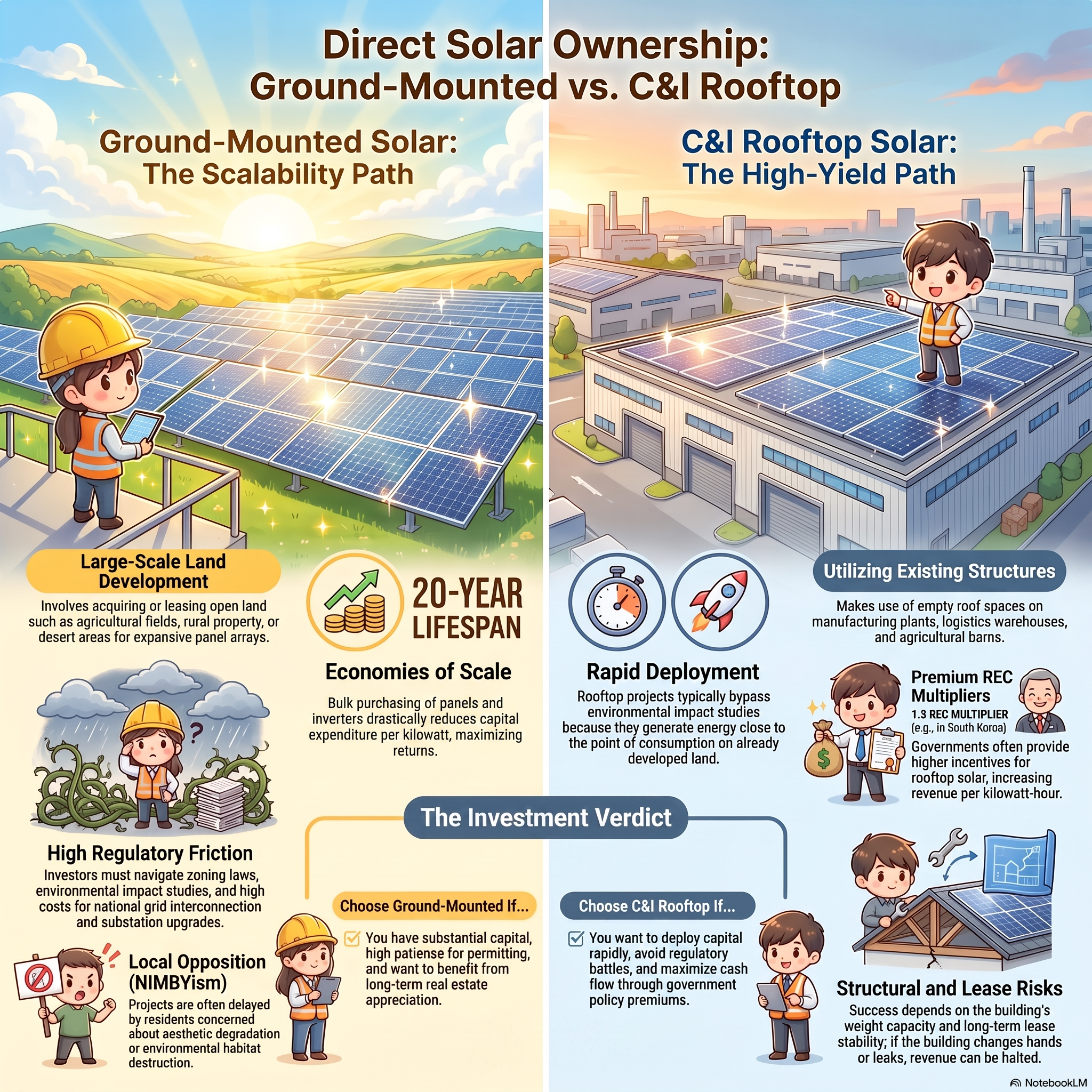
Owning a Solar Plant in Your Name: Ground-Mounted vs. Commercial Rooftop
Now that we have explored fractional investments through platforms, it is time to discuss direct ownership. Building a solar power plant under your own name requires significant capital and hands-on management, but it eliminates platform fees and leaves you with a tangible, long-term physical asset.
When you decide to build a solar plant, the first major decision is site selection. The industry generally divides projects into two main categories: Ground-Mounted (utility-scale or standalone arrays on land) and Commercial/Industrial (C&I) Rooftop solar. Each offers distinct profitability profiles, regulatory hurdles, and governmental incentives. Let us analyze both to determine which strategy best suits your investment goals.
1. Ground-Mounted Solar: The Power of Scalability
Ground-mounted solar involves acquiring or leasing large tracts of open land—such as agricultural fields, unused rural property, or desert areas—and installing expansive arrays of solar panels.
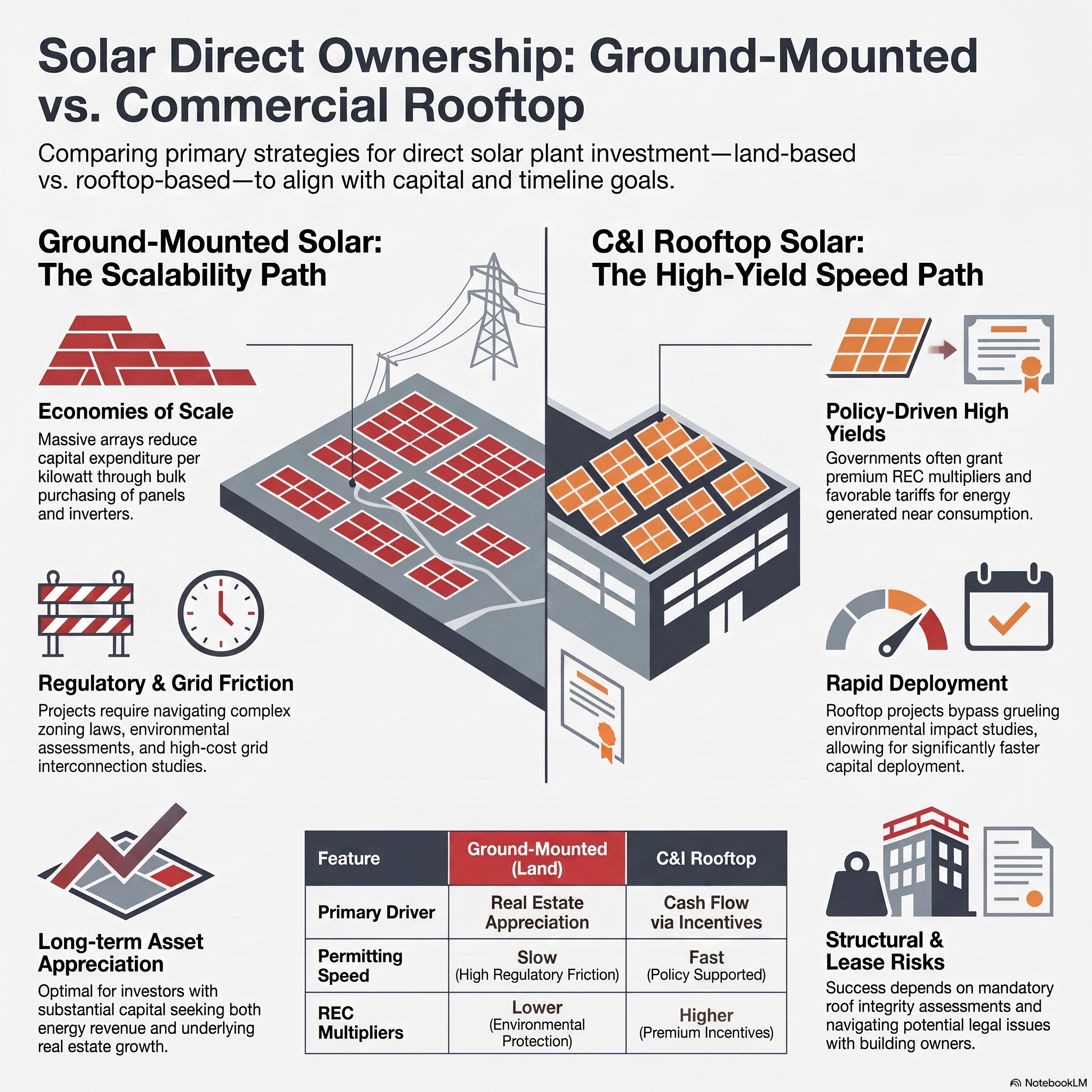
* The Advantage of Scale: The primary allure of ground-mounted solar is unrestricted scalability. If you have the capital, you can develop anything from a 1-megawatt (MW) community solar farm to a 100-MW utility-scale project. By building on a massive scale, investors achieve significant economies of scale. Buying panels, inverters, and mounting structures in bulk drastically reduces the capital expenditure (CapEx) per kilowatt installed, thereby improving the overall financial return over the 20-year lifespan of the project.
* The Hurdles (Zoning, Interconnection, and NIMBYism): Developing raw land is fraught with regulatory friction. Before pouring any concrete, investors must navigate a labyrinth of zoning laws, environmental impact assessments, and local municipal regulations.
* Practical Example: Suppose an investor purchases 10 acres of cheap rural land in Spain or Texas to build a 2MW solar farm. While the land was inexpensive, the local municipality might have strict setback requirements, prohibiting solar installations within a certain distance of residential areas or public roads. Furthermore, connecting a large plant to the national grid requires an interconnection study. Upgrading the local electrical substation to handle the new power load can cost hundreds of thousands of dollars. Lastly, "Not In My Backyard" (NIMBY) opposition from local residents concerned about aesthetic degradation or glare can severely delay or even kill the project. Additionally, governments often provide lower Renewable Energy Certificate (REC) multipliers for ground-mounted systems to discourage the destruction of natural habitats.
2. C&I Rooftop Solar: Fast-Tracking Permitting and Maximizing Incentives
Commercial and Industrial (C&I) Rooftop solar involves utilizing the massive, empty roof spaces of existing structures, such as manufacturing plants, logistics warehouses, and agricultural barns.
* The Advantage of Speed and Policy Support: Governments globally are aggressively pushing for rooftop solar because it generates clean energy close to where it is consumed, reducing transmission losses without destroying pristine land. Consequently, rooftop projects almost entirely bypass grueling environmental impact studies and zoning battles. Permitting is exponentially faster. More importantly, governments often grant premium REC multipliers or highly favorable feed-in tariffs (FIT) for rooftop installations. This premium pricing means that every kilowatt-hour sold generates more revenue compared to a ground-mounted system, significantly accelerating the return on investment (ROI).
* The Hurdles (Structural Integrity and Lease Risks): Since you are building on top of an existing structure, the roof must be able to support the additional weight of the panels and mounting hardware. A strict structural engineering assessment is mandatory.
* Practical Example: An investor decides to lease the roof of a large logistics warehouse to install a 500kW system. Because there is no land acquisition cost, the initial CapEx is highly efficient. However, the investor faces unique risks. If the roof develops a severe leak five years into the project, the solar array might need to be temporarily dismantled for roof repairs, causing a total halt in revenue generation. Furthermore, if the warehouse owner files for bankruptcy and the building changes hands, renegotiating the roof lease with the new owner can become a legal nightmare. Therefore, assessing the structural health of the building and the financial stability of the landlord is absolutely critical.
3. The Investment Verdict
If you possess substantial capital, have the patience to endure a 1-to-2-year permitting and grid-interconnection process, and wish to benefit from the underlying real estate appreciation, Ground-Mounted Solar is your optimal path. It is the realm of true infrastructure development.
Conversely, if you want to deploy capital rapidly, avoid environmental regulatory battles, and maximize your cash flow through government policy premiums—or if you already own a commercial warehouse with unused roof space—C&I Rooftop Solar offers a superior, high-yield investment strategy with significantly lower administrative friction.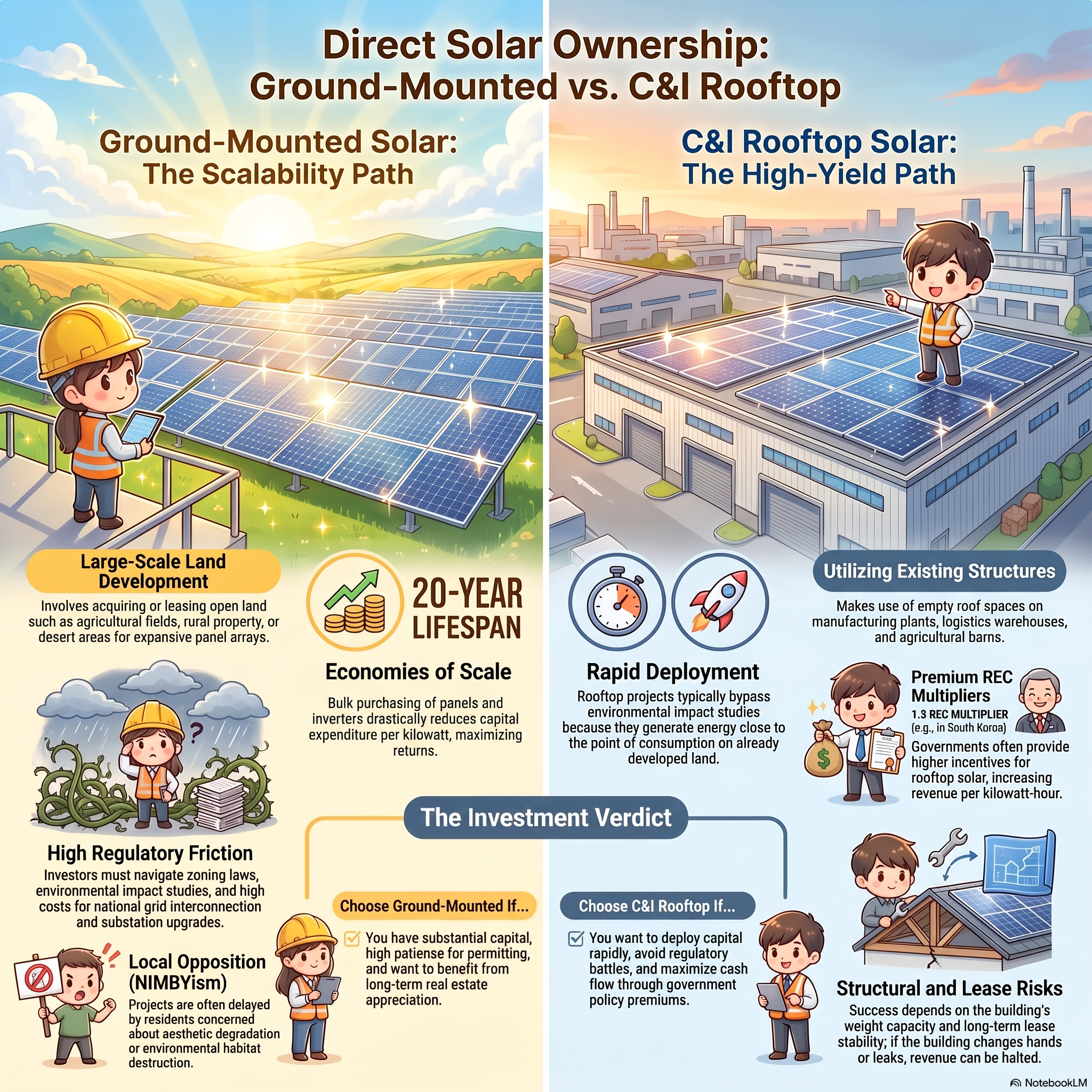
 728x90
'손 가는 대로 > 태양광' 카테고리의 다른 글
6-3) 농어촌의 새로운 수익 모델: 영농형 vs 염해농지형 (0) 2026.07.29 6-2) 가장 뜨거운 트렌드: 산업단지 지붕형(공장 지붕) 태양광 (0) 2026.07.28 5-5) 실전 케이스 스터디: 원금 손실을 막는 플랫폼 재무건전성 체크리스트 (0) 2026.07.24 5-4) 수익의 성격과 세금: 조각 투자 수익 절세법과 토큰증권(STO) 트렌드 (0) 2026.07.23 5-3) 출구 전략(Exit)과 유동성: 20년 장기 투자, 중간에 돈이 필요하다면? (0) 2026.07.23