-
5-5) 실전 케이스 스터디: 원금 손실을 막는 플랫폼 재무건전성 체크리스트손 가는 대로/태양광 2026. 7. 24. 08:29728x90
5장 플랫폼을 활용한 조각 투자
5) 실전 케이스 스터디: 원금 손실을 막는 플랫폼 재무건전성 체크리스트
---
성공적인 태양광 투자의 첫걸음은 화려한 수익률을 좇는 것이 아니라, 내 피 같은 원금을 잃지 않는 안전장치를 확인하는 것입니다. 조각 투자는 스마트폰 앱으로 간편하게 이루어지지만, 그 이면에는 수많은 법적, 재무적 뼈대가 존재합니다.
만약 우리가 투자금을 입금한 '플랫폼 회사'가 파산한다면 어떤 일이 벌어질까요? 과거 P2P 금융 사태의 교훈을 바탕으로, 내 원금을 완벽하게 지키기 위해 반드시 확인해야 할 플랫폼 재무건전성 체크리스트를 실전 케이스 스터디와 함께 살펴보겠습니다.
1. 케이스 스터디: 어느 조각 투자 플랫폼의 파산
몇 년 전, 높은 수익률을 내세우며 투자자를 끌어모았던 가상의 'A 펀딩 플랫폼' 사태를 예로 들어보겠습니다. 이 회사는 태양광 발전소를 짓겠다며 투자자들로부터 수십억 원을 모았습니다. 초기에는 약속된 이자가 꼬박꼬박 들어왔습니다.
하지만 플랫폼 회사의 경영진이 무리한 사업 확장으로 회사 운영 자금을 탕진하면서 플랫폼이 파산하고 말았습니다. 이때 가장 큰 문제는 투자자들의 돈과 회사의 운영 자금이 하나의 통장에 섞여 있었다는 점입니다. 회사의 빚쟁이(채권자)들이 통장을 압류하자, 투자자들은 태양광 발전소의 실체가 있었음에도 불구하고 원금을 한 푼도 돌려받지 못하는 참사가 발생했습니다.
이러한 비극을 막기 위해 우리는 투자 전 반드시 아래의 4가지 체크리스트를 점검해야 합니다.
2. 원금 방어를 위한 철통 체크리스트 4계명
체크리스트 1: 투자금의 분리 보관 (제3자 예치 시스템)
가장 먼저 확인해야 할 것은 내가 입금한 돈이 누구의 통장으로 들어가는가입니다. 플랫폼 회사의 법인 통장으로 직접 돈이 들어간다면 무조건 투자를 피해야 합니다.
정상적이고 안전한 플랫폼은 투자자의 돈을 자사 통장이 아닌, NH농협은행, 신한은행 등 공신력 있는 시중 은행이나 신탁 회사의 '에스크로(Escrow) 계좌'에 분리하여 보관합니다. 이를 제3자 예치금 관리 시스템이라고 부릅니다. 이 시스템이 적용되어 있다면 플랫폼 회사가 파산하더라도 내 투자금은 은행에 안전하게 묶여 있으므로 원금을 100퍼센트 지킬 수 있습니다. 대한민국에서는 '온라인투자연계금융업법(온투법)'에 따라 금융위원회에 정식 등록된 업체라면 이 시스템이 의무화되어 있습니다.
체크리스트 2: 완벽한 도산절연과 SPC 소유권
앞서 2절에서 설명한 특수목적법인(SPC)이 실질적으로 잘 작동하는지 서류로 확인해야 합니다.
투자를 진행할 때 제공되는 '투자 설명서'를 열어, 해당 태양광 발전소의 사업자등록증과 발전사업허가증 상의 대표가 플랫폼 회사가 아닌 독립된 'SPC 법인명'으로 되어 있는지 점검합니다. 플랫폼 회사는 단지 SPC의 업무를 대행해 주는 대리인일 뿐이어야 합니다. 그래야만 플랫폼 회사가 파산해도, 우리의 발전소는 아무런 타격 없이 계속해서 전기를 팔고 수익을 낼 수 있습니다.
체크리스트 3: 담보의 확실성 (1순위 근저당권)
만약 지분 투자가 아니라 발전소를 짓는 자금을 빌려주는 '대출형(P2P) 조각 투자'라면, 돈을 갚지 못할 경우에 대비한 담보가 필수입니다.
투자 설명서에서 '1순위 근저당권 설정'이라는 단어를 반드시 찾으셔야 합니다. 이는 만약 발전소에 문제가 생겨 경매로 넘어가게 될 경우, 발전소를 판 돈을 은행이나 다른 빚쟁이들보다 우리(개인 투자자들)가 가장 먼저 챙겨갈 수 있는 강력한 법적 권리입니다. 만약 2순위나 3순위라면 원금 손실 확률이 매우 높아집니다. 추가로, 태양광 패널 자체에 대한 동산 담보나 발전 수익금에 대한 질권(수익금을 담보로 잡는 것)이 설정되어 있는지도 확인하면 더욱 안전합니다.
체크리스트 4: 플랫폼 회사의 자체 재무제표와 백업 플랜
마지막으로 플랫폼 회사 자체의 체력을 봐야 합니다. 금융감독원 전자공시시스템(DART)이나 기업 정보 사이트를 통해 해당 플랫폼 회사의 재무제표를 확인합니다. 지속적인 적자로 인해 자본이 완전히 바닥난 '완전 자본잠식' 상태라면 투자를 보류하는 것이 좋습니다.
물론 SPC와 제3자 예치를 통해 원금은 안전하게 분리되어 있더라도, 앱을 관리하는 회사가 망하면 새로운 관리 업체를 찾을 때까지 이자 지급이 몇 달간 지연되는 등 심각한 스트레스를 겪게 됩니다. 우량한 플랫폼은 파산 시 발전소 관리와 투자금 배분 업무를 즉각적으로 넘겨받을 '대체 업무 수탁사(Backup Servicer)'를 사전에 지정해 둡니다. 이 백업 플랜이 투자 설명서에 명시되어 있는지 질문하고 확인하는 것이 고수들의 투자법입니다.
태양광 조각 투자는 15년에서 20년을 내다보는 장기 레이스입니다. 연 1퍼센트의 추가 수익률에 현혹되기보다는, 어떤 악천후 속에서도 내 자산을 지켜줄 수 있는 플랫폼의 튼튼한 방어막을 확인하는 데 시간을 투자하시기 바랍니다.
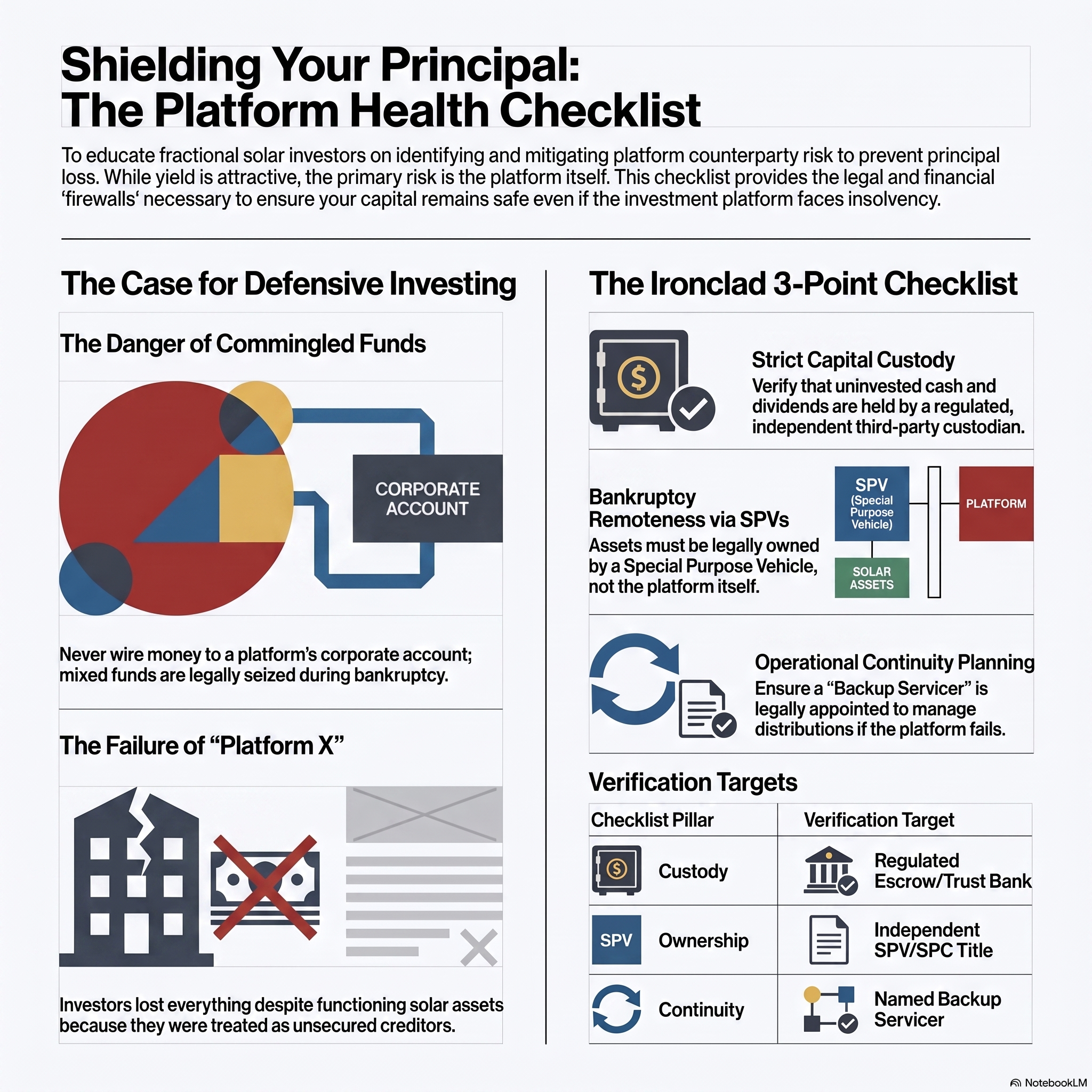
---
Practical Case Study: Platform Financial Health Checklist to Prevent Principal Loss
When engaging in fractional solar investments, the primary focus should never be the advertised yield; it must always be the preservation of your principal. While investing through a sleek smartphone app feels effortless, the digital interface masks a complex web of legal and financial structures.
What happens to your money if the Silicon Valley startup or FinTech company running the platform suddenly goes bankrupt? Let us conduct a practical case study and review the ultimate due diligence checklist every investor must execute to shield their capital from platform counterparty risk.
1. Case Study: The Collapse of a FinTech Aggregator
To understand the risks, we look at historical parallels from the early days of peer-to-peer (P2P) real estate and unregulated crypto yield platforms. Let us analyze a hypothetical but highly realistic scenario: "Platform X."
Platform X promised retail investors an attractive 10% annual yield on commercial solar arrays. Thousands of investors transferred millions of dollars to fund these projects. However, the tech startup was burning through its venture capital funding to acquire new users and run expensive marketing campaigns. When venture funding dried up, Platform X filed for bankruptcy.
The catastrophic flaw was "Commingling of Funds." Platform X had deposited investor capital directly into its own corporate operating bank accounts. When creditors and liquidators seized the company's assets, the investors' funds were legally classified as the company's operational capital. The investors were treated as unsecured creditors, standing at the back of the line. Despite the solar panels generating electricity perfectly on warehouse roofs, the investors lost their entire principal.
To prevent this nightmare scenario, modern fractional solar investors must rigorously apply the following four-point checklist.
2. The Ironclad Due Diligence Checklist
Checklist Item 1: Strict Capital Custody (The Escrow Mandate)
The absolute first rule of platform investing is examining the flow of funds. Never wire money directly to a platform's corporate bank account.
You must verify in the prospectus that your capital is held by a regulated, independent third-party custodian or trust bank (e.g., Bank of New York Mellon, Wells Fargo, or their regional equivalents). This system ensures that your uninvested cash and the incoming dividend payments are entirely ring-fenced. If the platform shuts its doors tomorrow, the custodian bank still holds your money safely, completely out of reach of the platform's creditors.
Checklist Item 2: Verifiable Bankruptcy Remoteness
As discussed in previous chapters, the physical solar asset must be housed in an independent Special Purpose Vehicle (SPV) or Limited Liability Company (LLC).
When reviewing the investment contract, check the legal owner of the solar plant. The title of the asset, the land lease, and the Power Purchase Agreement (PPA) with the utility company must all be under the SPV's name, not the platform's name. The platform should solely act as an administrative manager. This ensures that the physical asset producing your dividends is fully insulated from the corporate health of the tech company.
Checklist Item 3: Operational Continuity and the Backup Servicer
An often-overlooked risk is administrative paralysis. Even if your funds are in escrow and the asset is in an SPV, what happens if the platform’s app goes dark? Who will bill the utility company, pay the maintenance crews, and calculate your monthly dividend?
Top-tier platforms mitigate this by establishing an "Operational Continuity Plan." They legally appoint a "Backup Servicer" at the inception of the project. A Backup Servicer is an independent financial administration firm that stands ready to immediately take over the management of the SPV and the distribution of dividends if the original platform ceases operations. You must look for the mention of a contracted Backup Servicer in the offering documents.
Checklist Item 4: Scrutinizing the Platform’s Runway and Venture Backing
Finally, you must evaluate the startup itself. While structural firewalls protect your principal, a platform bankruptcy will still cause administrative headaches, communication blackouts, and significant stress.
Examine the platform's financial health. Are they backed by reputable venture capital firms or major utility companies? Have they successfully raised Series A or Series B funding rounds, providing them with a substantial "cash runway" for the next few years? A platform that is transparent about its profitability, operational cash flow, and institutional backing is far less likely to face sudden insolvency.
Fractional solar is a long-term fixed-income strategy. Sacrificing capital security for a slightly higher advertised yield is a fundamental error. Take the time to verify the legal firewalls; true investment mastery lies in aggressive risk mitigation. 728x90
'손 가는 대로 > 태양광' 카테고리의 다른 글
6-2) 가장 뜨거운 트렌드: 산업단지 지붕형(공장 지붕) 태양광 (0) 2026.07.28 6-1) 확장성이 뛰어난 토지형 vs 인허가가 쉬운 일반 지붕형 (0) 2026.07.27 5-4) 수익의 성격과 세금: 조각 투자 수익 절세법과 토큰증권(STO) 트렌드 (0) 2026.07.23 5-3) 출구 전략(Exit)과 유동성: 20년 장기 투자, 중간에 돈이 필요하다면? (0) 2026.07.23 5-2) 투자 구조의 이해: 내 돈은 어떻게 발전소가 될까? (SPC 구조와 투자 원리) (0) 2026.07.22