-
6-2) 가장 뜨거운 트렌드: 산업단지 지붕형(공장 지붕) 태양광손 가는 대로/태양광 2026. 7. 28. 08:39728x90
6장 내 이름으로 된 발전소 갖기: 어디에 어떻게 지을까?
2) 가장 뜨거운 트렌드: 산업단지 지붕형(공장 지붕) 태양광
태양광 투자 A to Z, 6장 "내 이름으로 된 발전소 갖기"의 두 번째 시간은 '가장 뜨거운 트렌드: 산업단지 지붕형(공장 지붕) 태양광'입니다.
최근 태양광 투자 시장에서 가장 각광받는 분야를 꼽으라면 단연 산업단지 내 공장 지붕을 활용한 태양광 사업입니다. 과거에는 시골의 저렴한 임야나 농지에 대규모로 태양광을 설치하는 것이 유행이었지만, 최근에는 환경 파괴 논란과 지자체의 엄격한 규제로 인해 그 중심축이 도심과 산업단지로 완전히 이동했습니다. 왜 수많은 투자자와 에너지 기업들이 공장 지붕으로 몰려들고 있는지, 그 이유와 투자 구조, 그리고 주의해야 할 점을 상세히 분석해 보겠습니다.
1. 산업단지 지붕형 태양광이 폭발적으로 성장하는 이유
산업단지 공장 지붕이 최고의 투자처로 떠오른 데에는 세 가지 강력한 이유가 있습니다.
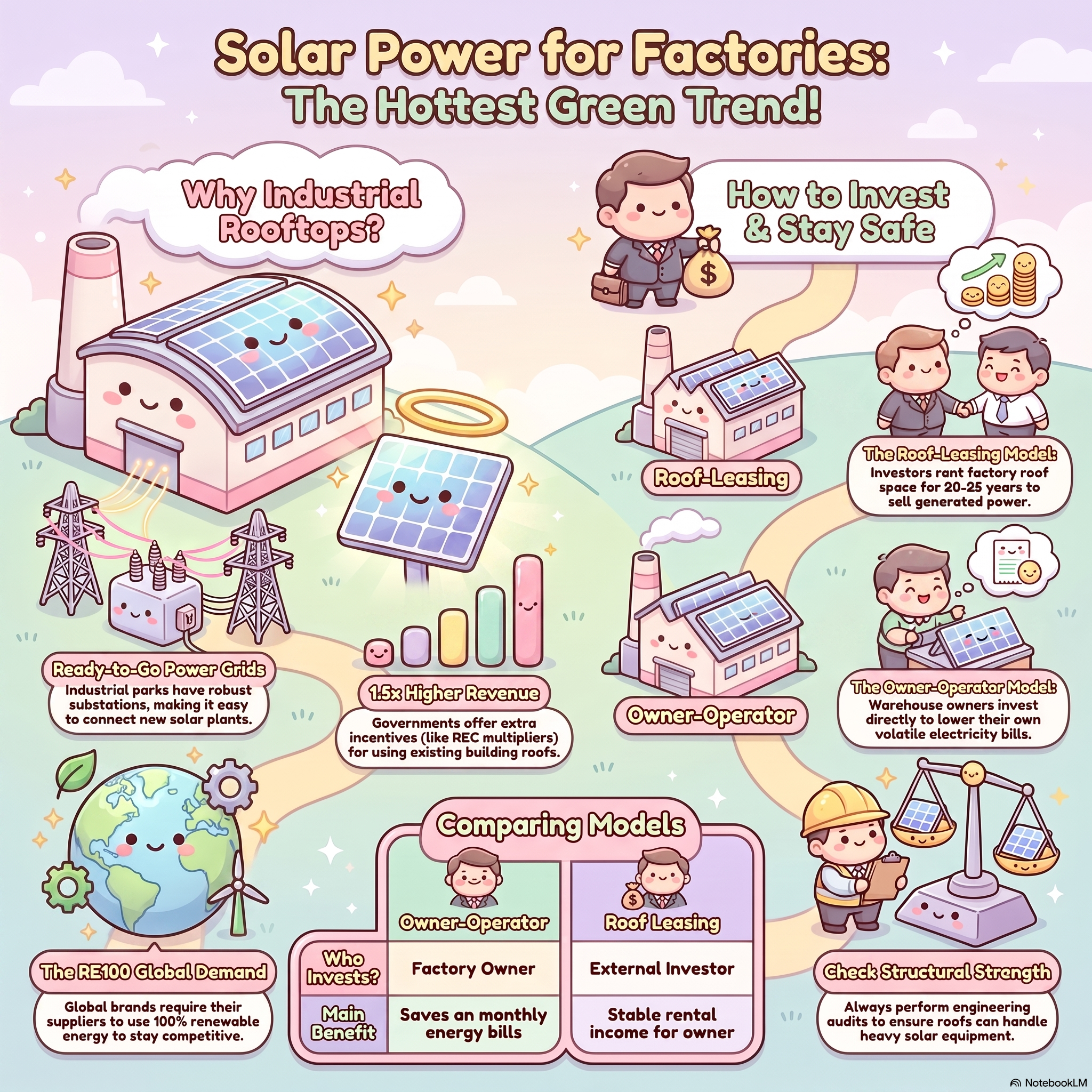
첫째, 압도적인 전력 계통(그리드) 인프라입니다. 태양광 투자의 가장 큰 리스크 중 하나는 발전소를 다 지어놓고도 한국전력의 송전 선로가 부족해 전기를 팔지 못하는 계통 연계 지연 문제입니다. 하지만 산업단지는 애초에 전기를 엄청나게 많이 쓰는 공장들을 위해 국가가 대규모 변전소와 튼튼한 전력망을 이미 깔아둔 곳입니다. 따라서 전기를 생산하자마자 전력망에 쉽게 연결하여 판매할 수 있습니다.
둘째, 최고 수준의 정책적 지원과 수익성입니다. 대한민국 정부는 자연 훼손 없이 재생에너지를 보급하기 위해 기존 건축물을 활용하는 지붕형 태양광에 가장 높은 신재생에너지 공급인증서(REC) 가중치인 1.5를 부여하고 있습니다. 똑같은 양의 전기를 생산해도 맨땅에 지은 발전소보다 1.5배의 추가 수익을 올릴 수 있어 투자금 회수 기간이 극적으로 단축됩니다.
셋째, 글로벌 RE100 트렌드와 수출 기업의 생존 문제입니다. 애플, BMW 등 글로벌 기업들이 납품업체에게 100퍼센트 재생에너지로 만든 제품만 요구하는 RE100 캠페인이 본격화되었습니다. 이에 따라 수출을 해야 하는 산업단지 내 공장주들이 자신의 공장 지붕에 태양광을 설치하려는 수요가 폭발적으로 증가하고 있습니다.
2. 구체적인 투자 모델과 예시
산업단지 지붕형 태양광 투자는 크게 두 가지 모델로 나뉩니다.
첫 번째는 공장주가 직접 자본을 투자하여 발전소를 소유하는 '자가용 및 발전 사업 겸용 모델'입니다.
예를 들어, 경북 구미 산업단지에 1,000평 규모의 지붕을 가진 자동차 부품 공장이 있다고 가정해 보겠습니다. 공장주가 약 6억 원을 투자해 500kW급 태양광 발전소를 지붕에 올립니다. 낮 시간에 생산된 전기는 공장의 기계를 돌리는 데 직접 사용하여 비싼 산업용 전기 요금을 크게 절감합니다. 그리고 주말이나 휴일처럼 공장이 쉴 때 생산된 전기는 한국전력에 팔아 추가 수익을 창출합니다.
두 번째는 외부 투자자가 지붕을 빌려 발전소를 짓는 '지붕 임대 모델'입니다.
공장주는 초기 투자금이 부담스럽거나 발전소 관리에 신경 쓰고 싶지 않을 수 있습니다. 이때 투자자(또는 투자 법인)가 공장주에게 20년간 매년 일정한 임대료를 지급하기로 계약하고, 지붕에 발전소를 짓습니다. 공장주는 노는 지붕을 빌려주어 아무런 리스크 없이 매년 수천만 원의 안정적인 임대 수익을 얻고, 투자자는 높은 REC 가중치를 바탕으로 전력을 판매해 고수익을 올리는 윈윈(Win-Win) 구조입니다.
3. 실전 투자 시 반드시 점검해야 할 리스크
하지만 공장 지붕 투자에도 치명적인 리스크가 존재하며, 이를 사전에 철저히 대비해야 합니다.
가장 중요한 것은 건물의 구조적 안전성입니다. 공장 지붕은 애초에 무거운 발전 설비를 견디도록 설계되지 않은 경우가 많습니다. 태양광 패널과 철골 구조물의 무게, 그리고 태풍이 불 때 견뎌야 하는 풍하중을 버틸 수 있는지 전문 기관의 구조 안전 진단을 반드시 통과해야 합니다. 만약 노후화된 지붕이라면 수천만 원을 들여 지붕 보강 및 방수 공사를 먼저 진행해야 하므로 초기 투자비가 급증할 수 있습니다.
또한, 지붕 임대 모델의 경우 임대인(공장주)의 재무 건전성이 핵심입니다. 20년이라는 긴 계약 기간 도중에 공장이 부도가 나서 건물이 경매로 넘어가게 되면, 지붕 위에 설치된 태양광 발전소의 권리관계가 매우 복잡해집니다. 최악의 경우 발전소를 철거해야 할 수도 있습니다. 따라서 지붕을 빌리기 전 해당 공장의 기업 신용도와 근저당 설정 여부를 철저히 분석해야 하며, 지상권 설정 등을 통해 투자자의 권리를 법적으로 완벽하게 보호해 두어야 합니다.
결론적으로 산업단지 지붕형 태양광은 높은 수익성과 인허가의 용이성 덕분에 현재 가장 매력적인 투자처입니다. 구조적 안전성과 공장주의 재무 리스크만 철저히 통제한다면, 20년간 매우 안정적인 현금 흐름을 창출하는 훌륭한 인프라 자산이 될 것입니다.
---
The Hottest Trend: Commercial and Industrial (C&I) Rooftop Solar
Hello, investors. Following our discussion on general site selection, we will now delve into the most lucrative and rapidly expanding segment of direct solar ownership: Commercial and Industrial (C&I) Rooftop Solar, with a specific focus on industrial parks and mega-factory roofs.
In recent years, the investment paradigm has shifted dramatically. Previously, investors flocked to cheap rural land for utility-scale projects. However, due to severe environmental permitting hurdles, land-use disputes, and grid interconnection delays in rural areas, massive capital has pivoted toward urban and industrial rooftops. Let us examine exactly why C&I rooftops are the reigning champions of solar investment, how the business models work, and the critical risks you must mitigate.
1. Why C&I Rooftops are the Hottest Asset Class
The explosive growth of industrial rooftop solar is driven by three distinct macro-level advantages.
First, superior grid infrastructure. The most significant bottleneck for ground-mounted solar is the lack of transmission lines in remote areas. Industrial parks, however, are specifically designed for heavy power consumption. They possess robust, high-capacity substations and transmission networks. For a solar investor, this means your newly built power plant can interconnect to the grid seamlessly and start generating revenue without years of waiting for grid upgrades.
Second, unprecedented policy support. Governments worldwide recognize that utilizing existing rooftops preserves pristine land. In response, they offer substantial incentives. In many European nations and Asian markets, rooftop installations receive premium feed-in tariffs or enhanced renewable energy certificate (REC) multipliers. In the United States, the Inflation Reduction Act (IRA) provides massive investment tax credits (ITC) specifically designed to encourage C&I rooftop deployments, drastically accelerating the return on investment.
Third, the corporate ESG and RE100 mandates. Major global brands are demanding their entire supply chains operate on 100 percent renewable energy. A factory manufacturing automotive parts or semiconductors must decarbonize its operations to remain in global supply chains. Consequently, factory owners are highly motivated to host solar installations on their facilities.
2. Investment Mechanisms and Real-World Examples
C&I rooftop investments generally operate under two distinct financial structures.
The first is the Owner-Operator model.
Consider a large logistics warehouse in the American Midwest or a manufacturing hub in Bavaria, Germany, possessing 100,000 square feet of flat, unobstructed roof space. The building owner invests their own capital to install a 1-Megawatt (1MW) solar array. The electricity generated is consumed primarily by the facility itself (behind-the-meter), drastically reducing their exposure to volatile commercial electricity rates. Any surplus power generated during weekends is exported to the grid for additional revenue.
The second is the Third-Party Ownership (TPO) or Roof-Leasing model.
Often, a factory owner lacks the capital or desire to manage a power plant. Here, you, as the solar investor, step in. You lease the roof space from the factory owner for a term of 20 to 25 years. The factory owner receives a steady, risk-free stream of rental income for utilizing previously dead space. You, the investor, own the solar asset, collect the tax incentives, and sell the generated power either directly back to the factory via a Power Purchase Agreement (PPA) at a negotiated rate, or directly to the national grid.
3. Critical Risk Factors and Due Diligence
While the yields are highly attractive, C&I rooftop investments harbor unique risks that require stringent due diligence.
The foremost risk is structural integrity. A factory roof must endure the sheer weight of thousands of solar panels and the heavy ballasted racking systems, alongside extreme wind loads and potential snow accumulation. A comprehensive structural engineering assessment is non-negotiable. If the roof is aged, it may require complete reinforcement or a total roof replacement before panel installation, which can severely inflate your initial capital expenditure.
Furthermore, in the roof-leasing model, you carry significant counterparty credit risk. You are entering a 20-year marriage with the building owner. If the manufacturing company goes bankrupt and the facility is foreclosed upon, the legal status of your solar array becomes highly precarious. You could face periods of non-operation or be forced to dismantle the system. Therefore, auditing the financial health of the landlord and securing ironclad legal easements or leasehold rights on the property title is imperative to shield your multi-million dollar asset.
In summary, C&I rooftop solar in industrial parks currently offers the best risk-adjusted returns in the renewable sector. By providing rapid grid connection, leveraging premium government incentives, and carefully mitigating structural and counterparty risks, investors can secure a highly profitable, long-term infrastructure asset.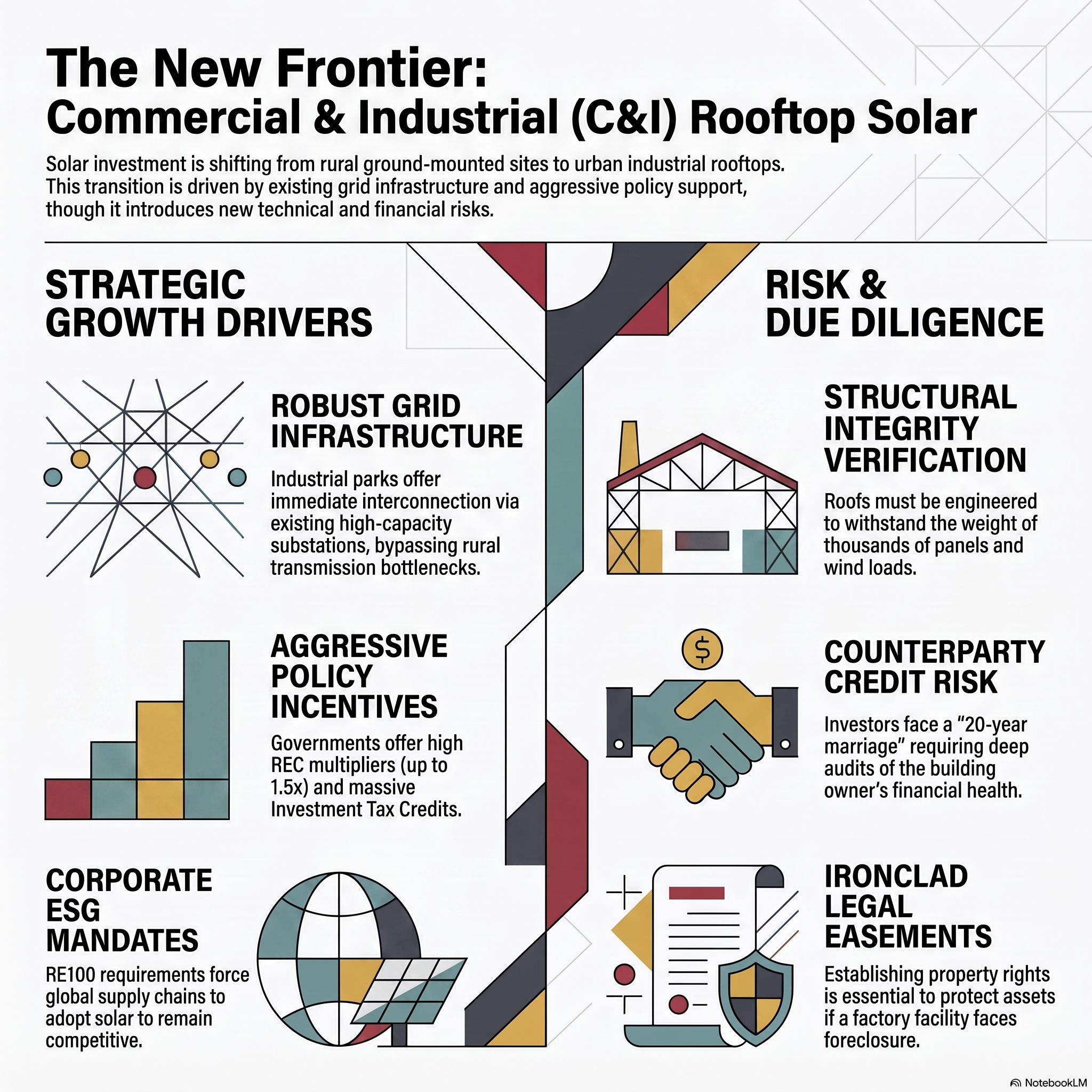 728x90
'손 가는 대로 > 태양광' 카테고리의 다른 글
태양광 발전과 준공일 (0) 2026.07.30 6-3) 농어촌의 새로운 수익 모델: 영농형 vs 염해농지형 (0) 2026.07.29 6-1) 확장성이 뛰어난 토지형 vs 인허가가 쉬운 일반 지붕형 (0) 2026.07.27 5-5) 실전 케이스 스터디: 원금 손실을 막는 플랫폼 재무건전성 체크리스트 (0) 2026.07.24 5-4) 수익의 성격과 세금: 조각 투자 수익 절세법과 토큰증권(STO) 트렌드 (0) 2026.07.23